Navigation



Healthier diets are associated with better mental health in adolescents

 Watch on YouTube
Key Findings
- A systematic review of studies examining the relationship between diet quality and mental health in adolescents' , published in Nutrients, found that healthier diets are associated with better mental health outcomes.
- Depression was the most often studied mental health outcome, but studies also examined anxiety, well-being, chronic stress, and various aggregated indicators.
- The study examined exposures that included vitamin D, omega-3s, polyphenol-rich foods, Mediterranean-style diet, and overall diet quality.
- Healthy dietary patterns were more consistently linked to better mental health than the use of single-nutrient supplements.
Understanding Adolescence as a Critical Developmental Period;
Adolescence is the period of development between childhood and adulthood, roughly from ages 10 to 19, or even 24 (Sawyer et al., 2018). Puberty is a period of rapid growth and physical development during which a child transforms into an adult. Adolescence is also a period of intense cognitive, emotional, and social change. Young people develop a stronger sense of identity, greater independence, and more complex ways of thinking. Diet quality and mental health in adolescents their relationships with parents, peers, and society also change, with peer relationships taking a prominent role.
Why Mental Health Disorders Often Begin in Adolescence?
However, adolescence (and the few years immediately preceding it) is also a period of life when the first symptoms of many mental health disorders first appear. Some estimates state that between 25% and 31% of adolescents experience mental health problems (Silva et al., 2020).
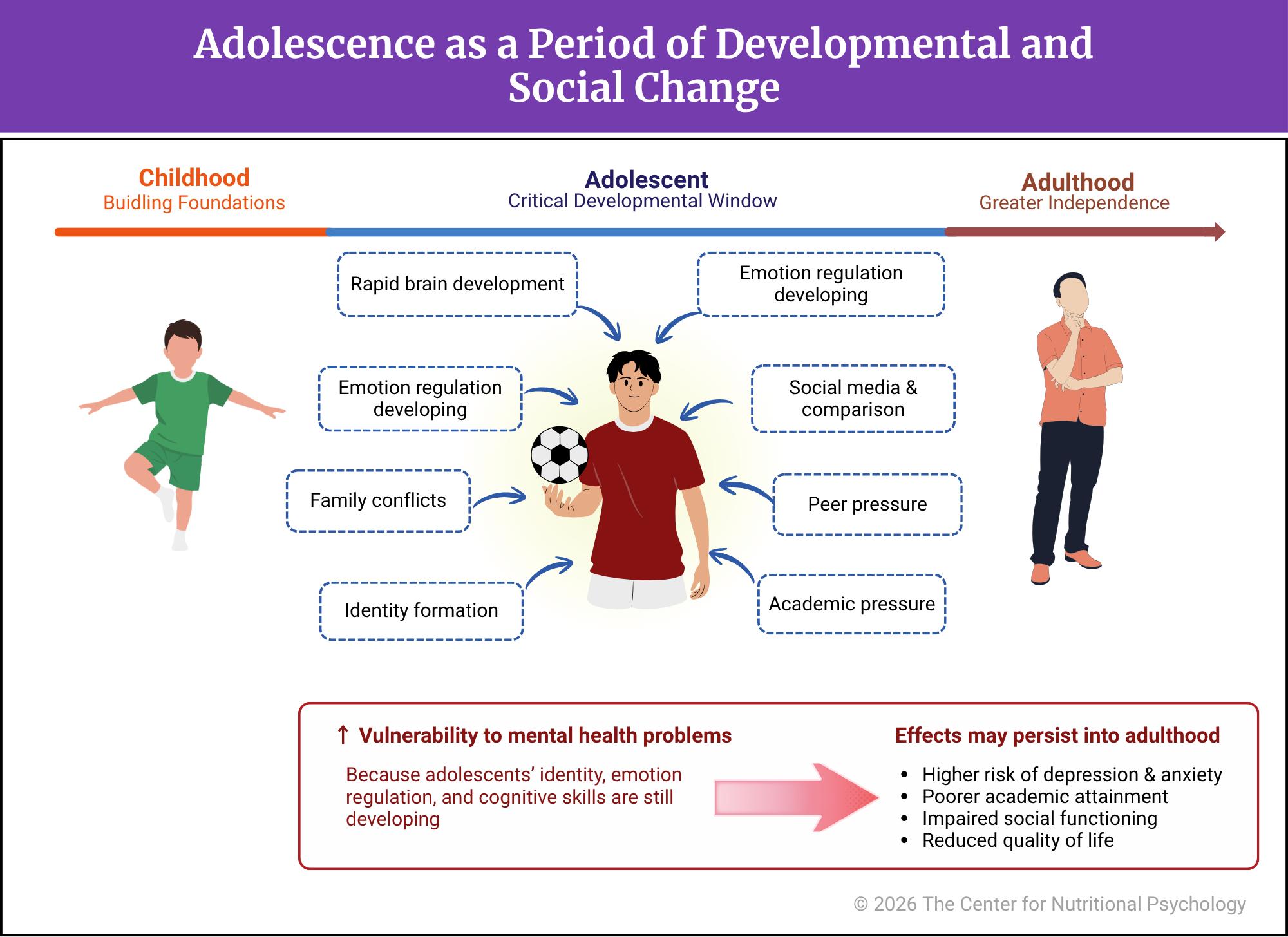
While the reasons for this are not fully understood, authors attribute these developments both to the rapid development of the brain during this period and to intense changes in the adolescents’ social environment. Adolescents face increasing social pressure from peers, including pressure to fit in, gain status, and avoid exclusion or bullying. At the same time, relationships with parents may become more conflictual or emotionally distant as adolescents seek greater independence.
Some estimates state that between 25% and 31% of adolescents experience mental health problems.
Their social world also expands through increased school demands, romantic relationships, and social media, which can increase feelings of comparison, rejection, and fear of missing out. Because adolescents’ identity, emotion regulation, and cognitive skills are still developing, these social changes can make adolescents more vulnerable to mental health problems. (Blakemore, 2019; Yurgelun-Todd, 2007).
“The consequences of early onset mental health problems are profound. Difficulties that emerge in adolescence frequently persist into adulthood, elevating risk for recurrent depression and anxiety, poorer academic attainment, impaired social functioning, and reduced quality of life. These sequelae can derail key developmental milestones and contribute to the intergenerational transmission of risk. This developmental period, therefore, represents a critical opportunity for prevention and early intervention,” Jade E. Tucker and his colleagues explain (Tucker et al., 2025)(see figure 1).
The Role of Diet Quality in Adolescent Mental Health
These researchers note that traditional interventions, such as psychotherapy and pharmacotherapy, are available but insufficient to meet the rising burden of adolescent mental health difficulties. They are also costly and have side effects, and are inaccessible to many.
On the other hand, a healthy diet is generally associated with better mental health. While it is well known that nutrient deficiencies can cause serious health problems (e.g., Silva et al., 2020; Tardy et al., 2020), studies show that overall unhealthy dietary patterns are associated with poorer mental health among both children and adolescents (O’Neil et al., 2014).
What Did This Study Examine?
Study author Jade E. Tucker and his colleagues conducted a systematic review of studies investigating the relationship between diet quality and mental health in adolescents aged 10 to 19 years (Tucker et al., 2025). They aimed to produce a synthesis of the most rigorous evidence available. That is why they focused on randomized controlled trials and longitudinal studies.
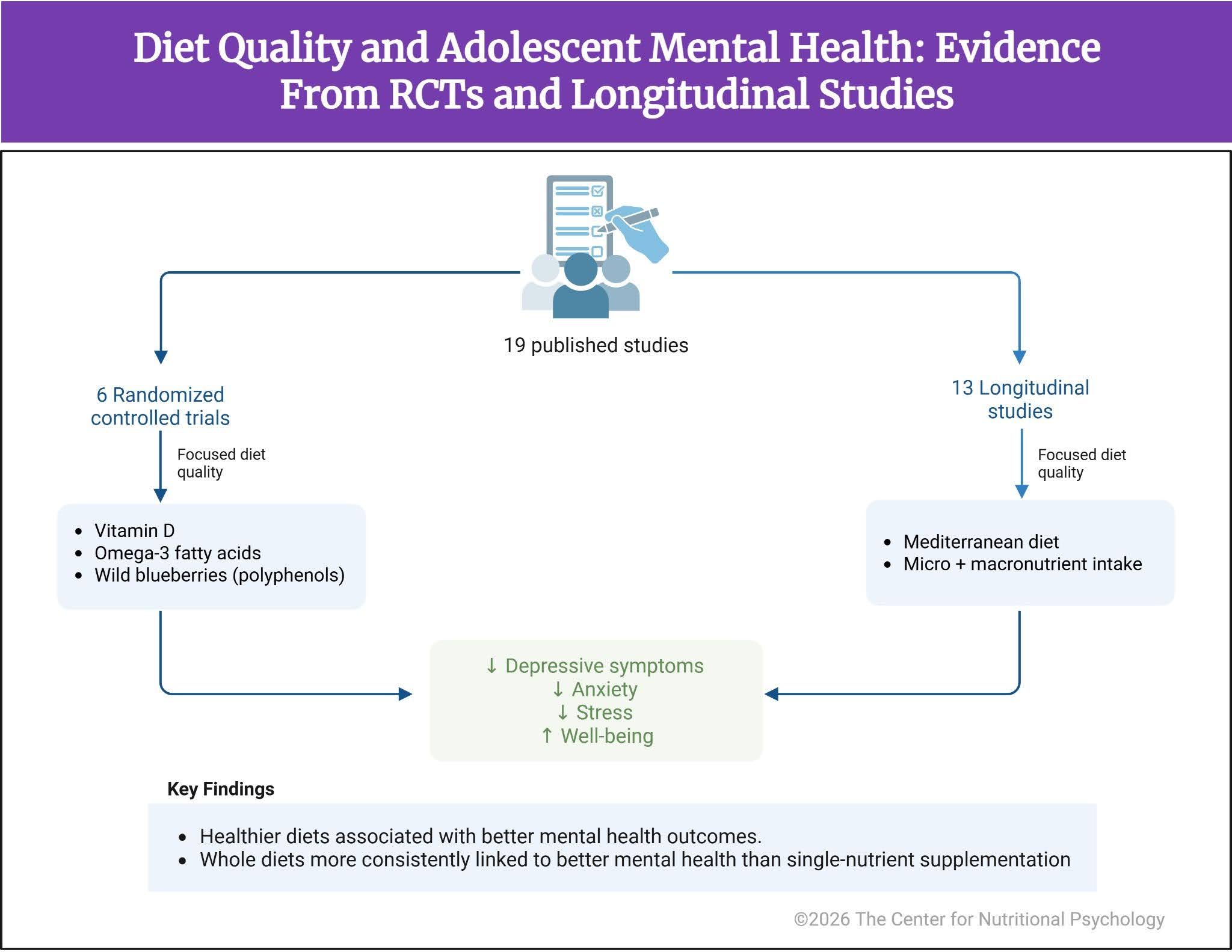
They searched scientific publication databases for papers reporting studies conducted on adolescents from the general population that met specific research design requirements. In the end, the search yielded 19 published studies, 6 of which were randomized controlled trials (i.e., experiments).
Key Findings on Diet Quality and Mental Health in Adolescents:
The 6 randomized controlled trials examined the effects of vitamin D supplementation, omega-3 fatty acids, and wild blueberries (i.e., polyphenol-rich whole foods).
The other 13 studies focused on the Mediterranean Diet, micro- and macronutrient intake, overall diet quality, and soft drink intake. Depression was the most often studied mental health outcome, but included studies also examined anxiety, well-being, distress, and various more general mental health indicators.
Across different study designs, healthier dietary patterns were associated with fewer depressive symptoms, while poorer diet quality was linked to increased psychological distress. More importantly, whole-diet quality and adherence to a healthy dietary pattern were more consistently associated with favorable adolescent mental health than single-nutrient supplementation.
Healthier dietary patterns were associated with fewer depressive symptoms, while poorer diet quality was linked to increased psychological distress.
Why Diet Quality Matters for Adolescent Mental Health?
These findings suggest that diet can be an actionable target for supporting adolescent mental health. It is possible that creating an environment where children and adolescents have access to healthy, nutritious foods in sufficient quantities could meaningfully reduce their mental health risks while also improving overall health. Moreover, these findings suggest that improving the overall diet quality may be far more valuable than adding individual supplements to children’s diets. Healthy diets contain vast numbers of bioactive compounds, many of which science has yet to identify, and they may collectively provide benefits to the developing body that single-nutrient supplements cannot.
Limitations to Consider
The measurement of mental health symptoms across studies included in this systematic review lacked standardization. Different studies used different tools and sometimes even measured psychological characteristics less directly related to mental health (e.g., self-efficacy). Dietary exposures studied also ranged from general diet quality indices based on national guidelines to adolescent-specific measures. Because of this, it is difficult to compare findings from different studies and say precisely how much they agree or disagree. Additionally, the examined studies were dominated by depression outcomes, leaving many other categories of mental health symptoms comparatively underexplored.
The Bottom Line
In spite of the limitations, this review generally indicates that adolescents adhering to healthy dietary patterns tend to have better mental health and to be less likely to develop mental health disorders compared to their peers with less healthy dietary patterns. Importantly, an overall healthy diet seems to be more consistently associated with lower mental health risk than specific single-nutrient supplements.
The paper “A Recipe for Resilience: A Systematic Review of Diet and Adolescent Mental Health” was authored by Jade E. Tucker, Anthony M. Brennan, David Benton, and Hayley A. Young.
Frequently Asked Questions
Yes, healthier dietary patterns are consistently associated with better mental health in adolescents, including fewer depressive symptoms and lower psychological distress.
No, overall diet quality shows more consistent benefits than single-nutrient supplementation.
Studies examined depression, anxiety, stress, well-being, and broader psychological indicators.
Adolescence involves major brain, social, and emotional changes, making individuals more vulnerable to mental health disorders.
Studies vary in measurement methods and focus heavily on depression, limiting comparability across findings.
References
Blakemore, S.-J. (2019). Adolescence and mental health. The Lancet, 393(10185), 2030–2031. https://doi.org/10.1016/S0140-6736(19)31013-X
O’Neil, A., Quirk, S. E., Housden, S., Brennan, S. L., Williams, L. J., Pasco, J. A., Berk, M., & Jacka, F. N. (2014). Relationship Between Diet and Mental Health in Children and Adolescents: A Systematic Review. American Journal of Public Health, 104(10), e31–e42. https://doi.org/10.2105/AJPH.2014.302110
Sawyer, S. M., Azzopardi, P. S., Wickremarathne, D., & Patton, G. C. (2018). The age of adolescence. The Lancet Child & Adolescent Health, 2(3), 223–228. https://doi.org/10.1016/S2352-4642(18)30022-1
Silva, S. A., Silva, S. U., Ronca, D. B., Gonçalves, V. S. S., Dutra, E. S., & Carvalho, K. M. B. (2020). Common mental disorders prevalence in adolescents: A systematic review and meta-analyses. PLOS ONE, 15(4), e0232007. https://doi.org/10.1371/journal.pone.0232007
Tardy, A.-L., Pouteau, E., Marquez, D., Yilmaz, C., & Scholey, A. (2020). Vitamins and Minerals for Energy, Fatigue and Cognition: A Narrative Review of the Biochemical and Clinical Evidence. Nutrients, 12(1), Article 1. https://doi.org/10.3390/nu12010228
Tucker, J. E., Brennan, A. M., Benton, D., & Young, H. A. (2025). A Recipe for Resilience: A Systematic Review of Diet and Adolescent Mental Health. Nutrients, 17(23), 3677. https://doi.org/10.3390/nu17233677
Yurgelun-Todd, D. (2007). Emotional and cognitive changes during adolescence. Current Opinion in Neurobiology, Cognitive Neuroscience, 17(2), 251–257. https://doi.org/10.1016/j.conb.2007.03.009
Last updated:
Related Articles

How Does Nutrition Affect ADHD Symptoms and Mental Health?
02 October 2026