Navigation



What do people eat when they binge eat?

 Watch on YouTube
- A study published in the International Journal of Eating Disorders explored what people eat during binge eating episodes
- In a search of published studies, they found that 100% reported at least one highly processed food in binge-eating episodes, while only 32% reported consuming minimally processed food in these situations.
- Of all the food types reported in binge-eating episodes, 70% were classified as highly processed and 15% as minimally processed.
Most people have experienced a strong urge or craving to eat a specific food. The target of that urge is typically some food we like very much, very often something that we both enjoy and have not eaten in a while. In some cases, after eating the food, the craving stops. However, sometimes these cravings can be the start of an eating spree in which we feel we have lost control over how much we eat, and we end up consuming much more than we planned or usually eat. Such situations are called binge-eating episodes.
What is binge eating?
A binge eating episode is a situation in which a person eats an unusually large amount of food over a short period of time, accompanied by a subjective sense of loss of control over eating (American Psychiatric Association, 2013; Di Giacomo et al., 2022). During such an episode, the person may eat rapidly, continue eating despite feeling full, or eat when they are not physically hungry. The episode may be followed by discomfort, guilt, shame, or distress. It may occur after food cravings, but it can also be triggered by stress, unpleasant emotions, restrictive dieting, or other factors.
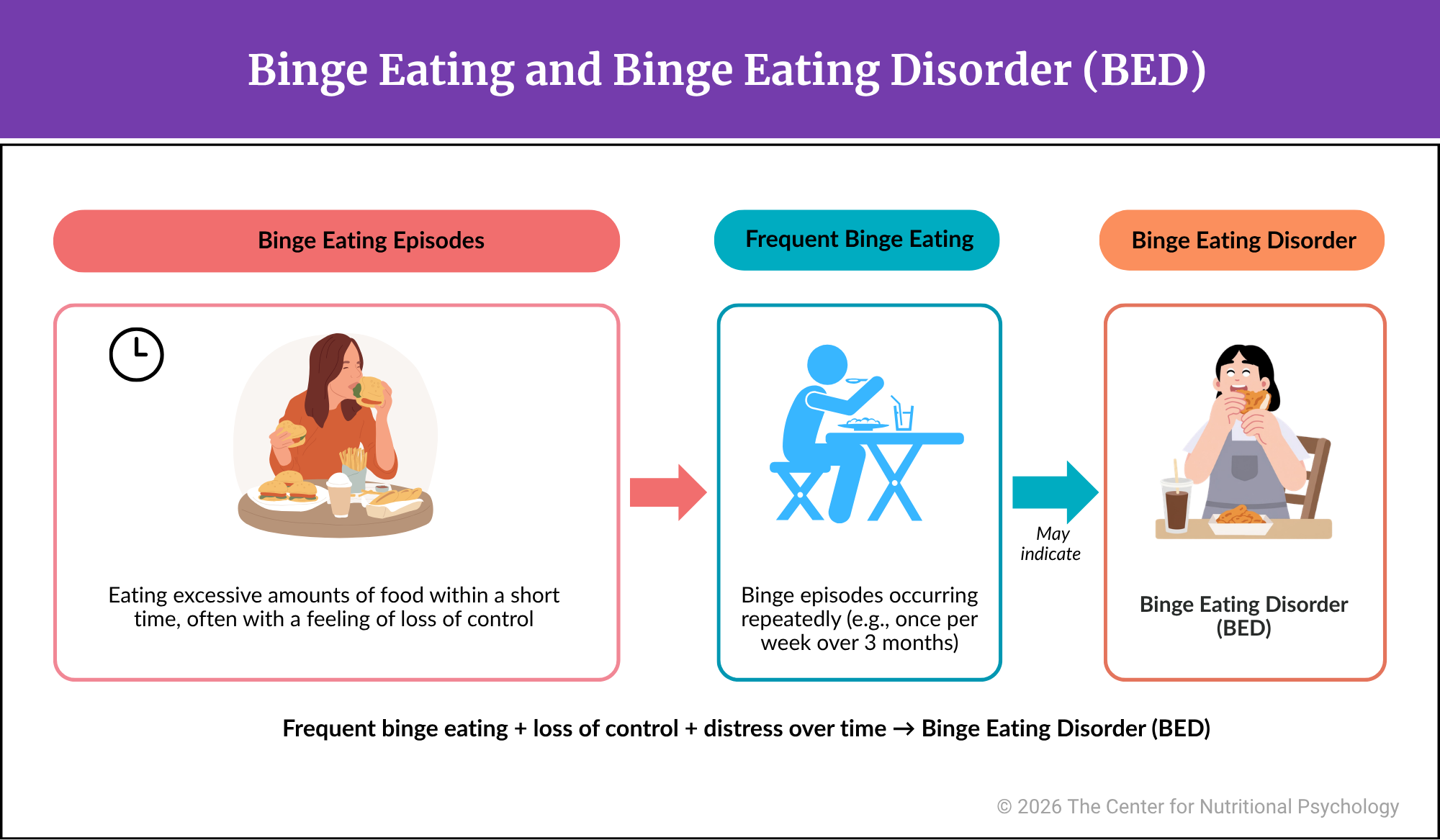
An isolated binge-eating episode does not necessarily mean that the person has an eating disorder. When binge eating occurs regularly, such as at least once a week for three months, it may indicate binge-eating disorder. Aside from being itself a mental health disorder, studies have found that binge eating disorder often co-occurs with other mental health disorders, most often mood disorders, anxiety disorders, and substance use disorders. In individuals with these disorders, binge eating disorder symptoms tend to be more severe (Kowalewska et al., 2024).
What Did the Study Examine About Binge Eating?
Study author Ingrid A. Worth and her colleagues analyzed published research to integrate evidence on the types of food people eat during binge-eating episodes (Worth et al., 2026). They noted that the presence of highly processed foods in most people’s food environments has increased in the past 60 years, coinciding with the rise in binge eating.
Highly processed or ultra-processed foods are industrial formulations made mostly or entirely from derived substances with few intact unprocessed or minimally processed food components (Hedrih, 2024a). They typically contain added sugars, salt, fats, flavorings, preservatives, and other additives. Examples include sugary drinks, packaged snacks, instant noodles, and many ready-to-eat meals. Because our brain reacts more strongly to foods rich in both easily digestible fats and sugars (Hedrih, 2024b; McDougle et al., 2024), these foods may exacerbate overeating.
By searching several scientific paper databases, these authors identified 41 studies that reported on specific foods consumed by human participants during binge-eating episodes. They classified those foods as highly processed based on the presence of refined carbohydrates and/or added fats.
Key Findings
Results showed that all studies included in the analysis reported at least one highly processed food consumed during binge-eating episodes. Only 32% of studies reported consumption of minimally processed foods during a binge-eating episode, while 68% did not report any such consumption. There were no studies that reported only minimally processed foods consumed in a binge-eating episode.
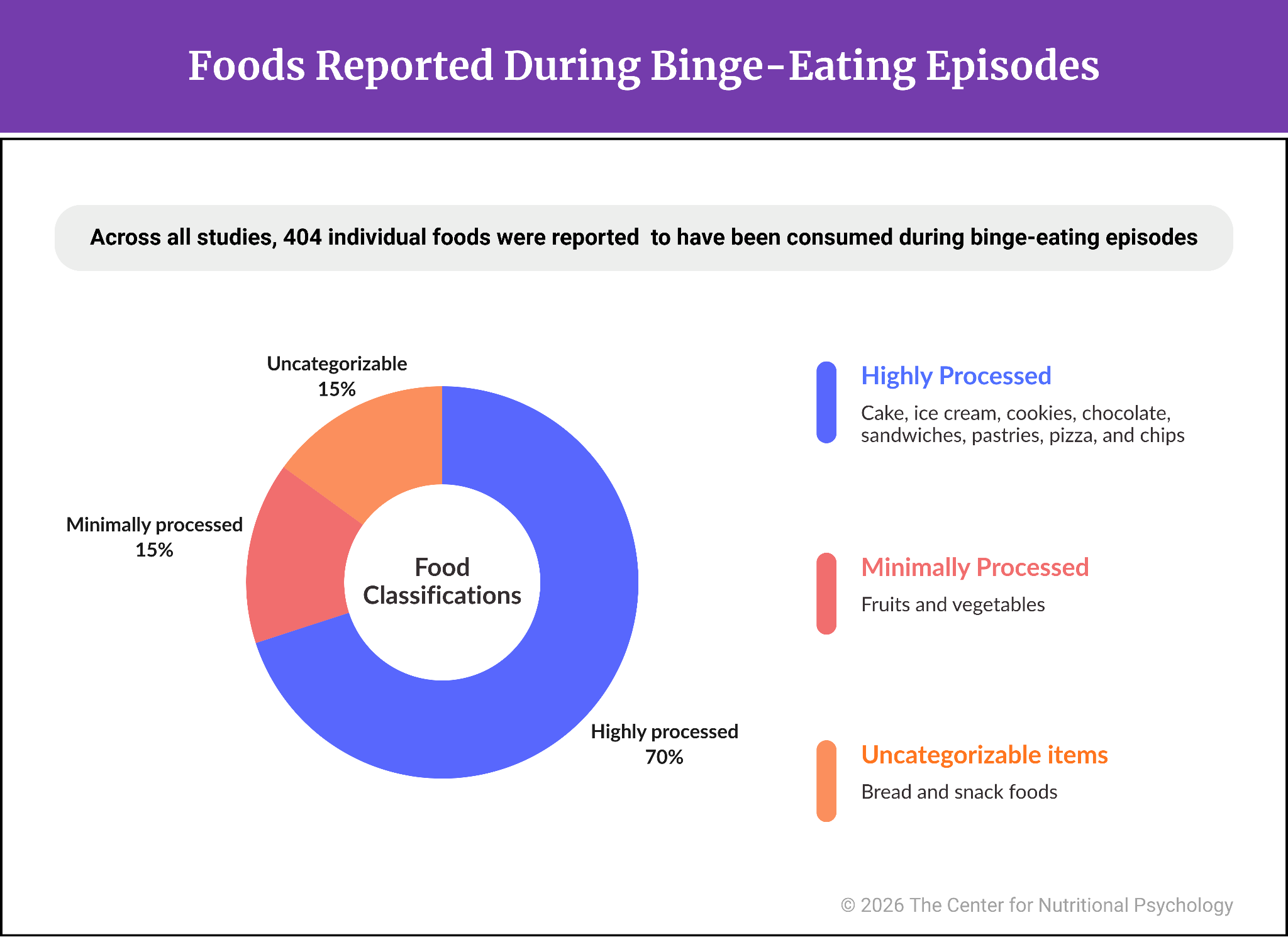
Across all studies, 404 individual foods were reported to have been consumed during binge-eating episodes. Of these, 70% were highly processed, 15% were minimally processed, and 15% were uncategorizable. The most frequently reported highly processed foods included cake (20 studies), ice cream (19), cookies (18), chocolate (16), sandwiches (13), pastries (12), pizza (11), and chips (10). The most frequently reported minimally processed foods were fruits and vegetables, while bread and “snack foods” were the most frequently cited uncategorizable items.
“The current Forum highlights the central role of highly processed foods in the composition of binge-eating episodes, while simultaneously revealing substantial limitations in how foods were documented,” the study authors concluded.
Why it matters
Many studies indicate that highly processed or ultra-processed foods may be a key contributor to the epidemics of obesity and chronic diseases (most importantly, type 2 diabetes) that have been unfolding worldwide in the last few decades (Magliano et al., 2019; Wong et al., 2022). They have also been implicated in the development of what some authors call food addiction, a condition closely related to binge eating disorder (Gearhardt et al., 2023). Because of this, examining the role highly processed foods have in binge-eating episodes is of great scientific importance.
Limitations to Consider
Authors of this study note that many of the studies they encountered did not report how many participants consumed each listed food item, making it unclear whether certain foods were consumed by a small subset of participants or by the majority of the sample. This limits the interpretation of the results. To address this methodological gap, these authors call for more standardized reporting of food in scientific publications.
“Improving food-level reporting, particularly with respect to processing, ingredients, preparation, and portion size, will be essential for determining how the changing food environment may influence binge-eating risk. Enhanced rigor in this domain would enable future studies to more fully apply established frameworks such as NOVA, as well as more accurately quantify the amount and types of foods consumed during binge-eating episodes,” they concluded.
The Bottom Line
The study found that highly processed foods have a central role in the composition of binge-eating episodes. Despite methodological limitations stemming from the lack of standardized reporting of foods consumed during binge-eating episodes across published studies, the fact that highly processed foods were consumed in all examined studies supports the notion that they indeed exacerbate vulnerabilities that lead to binge-eating episodes.
The study “Highly Processed Foods in Binge-Eating Episodes: The Importance of Improving Food Reporting” was authored by Ingrid A. Worth, Tera L. Fazzino, Kendrin R. Sonneville, Kelly L. Klump, and Ashley N. Gearhardt and can be found in the Nutritional Psychology Research Library (NPRL).
Frequently Asked Questions
A binge-eating episode is a situation in which a person eats an unusually large amount of food over a short period of time, accompanied by a subjective sense of loss of control while eating.
No, the diagnosis of binge eating disorder requires that binge-eating episodes happen regularly, for example, at least once a week for 3 months.
Highly processed or ultra-processed foods are industrial formulations made mostly or entirely from derived substances and various additives, with few intact, unprocessed, or minimally processed food components. They typically contain added sugars, salt, fats, flavorings, preservatives, or other additives. Examples include sugary drinks, packaged snacks, instant noodles, and many ready-to-eat meals.
No, this study only integrated reports on the types of food consumed during binge-eating episodes from published research studies. However, these results are only descriptive and insufficient to make any causal conclusions. This is not enough to make any definitive inferences about the nature of the relationship between highly processed foods and binge-eating disorder.
References
American Psychiatric Association. (2013). Diagnostic and statistical manual of mental disorders: DSM-5TM, 5th ed (pp. xliv, 947). American Psychiatric Publishing, Inc. https://doi.org/10.1176/appi.books.9780890425596
Definition & Facts for Binge Eating Disorder—NIDDK. (2026, May 31). National Institute of Diabetes and Digestive and Kidney Diseases. https://www.niddk.nih.gov/health-information/weight-management/binge-eating-disorder/definition-facts
Di Giacomo, E., Aliberti, F., Pescatore, F., Santorelli, M., Pessina, R., Placenti, V., Colmegna, F., & Clerici, M. (2022). Disentangling binge eating disorder and food addiction: A systematic review and meta-analysis. Eating and Weight Disorders – Studies on Anorexia, Bulimia and Obesity, 27(6), 1963–1970. https://doi.org/10.1007/s40519-021-01354-7
Gearhardt, A. N., Bueno, N. B., DiFeliceantonio, A. G., Roberto, C. A., Jiménez-Murcia, S., & Fernandez-Aranda, F. (2023). Social, clinical, and policy implications of ultra-processed food addiction. BMJ, e075354. https://doi.org/10.1136/bmj-2023-075354
Hedrih, V. (2024a). What are Ultra-Processed Foods Doing to Your Mental and Physical Health? CNP Articles in Nutritional Psychology. https://www.nutritional-psychology.org/what-are-ultra-processed-foods-doing-to-your-mental-and-physical-health/
Hedrih, V. (2024b, February 19). Consuming Fat and Sugar (At The Same Time) Promotes Overeating, Study Finds. CNP Articles in Nutritional Psychology. https://www.nutritional-psychology.org/16563-2/
Kowalewska, E., Bzowska, M., Engel, J., & Lew-Starowicz, M. (2024). Comorbidity of binge eating disorder and other psychiatric disorders: A systematic review. BMC Psychiatry, 24(1), 556. https://doi.org/10.1186/s12888-024-05943-5
Magliano, D. J., Islam, R. M., Barr, E. L. M., Gregg, E. W., Pavkov, M. E., Harding, J. L., Tabesh, M., Koye, D. N., & Shaw, J. E. (2019). Trends in incidence of total or type 2 diabetes: Systematic review. BMJ, 366, l5003. https://doi.org/10.1136/bmj.l5003
McDougle, M., de Araujo, A., Singh, A., Yang, M., Braga, I., Paille, V., Mendez-Hernandez, R., Vergara, M., Woodie, L. N., Gour, A., Sharma, A., Urs, N., Warren, B., & de Lartigue, G. (2024). Separate gut-brain circuits for fat and sugar reinforcement combine to promote overeating. Cell Metabolism. https://doi.org/10.1016/j.cmet.2023.12.014
Wong, M. C., Mccarthy, C., Fearnbach, N., Yang, S., Shepherd, J., & Heymsfield, S. B. (2022). Emergence of the obesity epidemic: 6-decade visualization with humanoid avatars. The American Journal of Clinical Nutrition, 115(4), 1189–1193. https://doi.org/10.1093/AJCN/NQAC005
Worth, I. A., Fazzino, T. L., Sonneville, K. R., Klump, K. L., & Gearhardt, A. N. (2026). Highly Processed Foods in Binge-Eating Episodes: The Importance of Improving Food Reporting. International Journal of Eating Disorders, 1–19. https://doi.org/10.1002/eat.70069
Last updated: