Nutrition-Mental Health Survey 2026

Join the conversation and play your part in helping to shape the field!

CNP is conducting a survey to help CNP better understand current perspectives and needs of the nutrition–mental health connection in education, research, and clinical practice.

Completing this 5-minute survey will help us identify barriers to collaboration between psychological and nutritional sciences and guide future program development, research priorities, and educational initiatives. Your responses are confidential and will play an important role in shaping resources that better serve our community. Thank you for sharing your voice!

Take the Survey
Navigation
  • Nutritional psychology
    • Home
    • What is Nutritional Psychology
    • Training in NP
    • About CNP
    • Meet the Team
    • NP FAQs
  • Education
    • Programs
    • Certificates
    • Courses
      • Overview
      • NP 110
      • NP 120
        • NP 120 Part I
        • NP 120 Part II
      • NP 150
        • NP 150 Part I
        • NP 150 Part II
      • NP 300
        • NP 310
        • NP 320
      • NP 500
        • NP 510
    • Micro-Degree
    • Course Scholarships
    • Learner Login
  • RESEARCH LIBRARY (NPRL)
    • Library Intro
    • Adult Population
    • Youth Population
      • Child and Adolescent
      • Neurodevelopmental
      • Maternal
      • Cooking
    • Membership
  • Resources
    • CNP Resources
      • Events
      • CNP News
      • Videos
      • Books
      • Reports
    • Encyclopedia
    • CNP Articles
    • Related Resources
    • Newsletter
  • Get Involved
    • Donate
    • Advocate
      • Introduction
      • Students
      • Professionals
      • Educators
      • Organization Advocacy
      • General
    • Be a Contributor
    • Faces of Nutritional Psychology
      • Faces Home
      • Personal Stories
      • Submission Guidelines
    • Newsletter
    • Research Announcement
  • Membership
    • Introduction
    • LOGIN
  • Contact
  • MEMBER LOGIN
  • STUDENT LOGIN
  • Nutritional psychology
    • Home
    • What is Nutritional Psychology
    • Training in NP
    • About CNP
    • Meet the Team
    • NP FAQs
  • Education
    • Programs
    • Certificates
    • Courses
      • Overview
      • NP 110
      • NP 120
        • NP 120 Part I
        • NP 120 Part II
      • NP 150
        • NP 150 Part I
        • NP 150 Part II
      • NP 300
        • NP 310
        • NP 320
      • NP 500
        • NP 510
    • Micro-Degree
    • Course Scholarships
    • Learner Login
  • RESEARCH LIBRARY (NPRL)
    • Library Intro
    • Adult Population
    • Youth Population
      • Child and Adolescent
      • Neurodevelopmental
      • Maternal
      • Cooking
    • Membership
  • Resources
    • CNP Resources
      • Events
      • CNP News
      • Videos
      • Books
      • Reports
    • Encyclopedia
    • CNP Articles
    • Related Resources
    • Newsletter
  • Get Involved
    • Donate
    • Advocate
      • Introduction
      • Students
      • Professionals
      • Educators
      • Organization Advocacy
      • General
    • Be a Contributor
    • Faces of Nutritional Psychology
      • Faces Home
      • Personal Stories
      • Submission Guidelines
    • Newsletter
    • Research Announcement
  • Membership
    • Introduction
    • LOGIN
  • Contact
Login
MEMBER LOGIN STUDENT LOGIN
Diet and Interoception

Diet and Interoception (Adult Population)

The CNP Diet and Interoception Research Category consolidates research exploring the interconnected relationship between dietary intake and interoception. To view each original study on the open internet, click “Original.” To view the CNP-written abstract summary, click “CNP Summary.” While only some of the CNP-written abstract summaries are available below for free, all abstract summaries are available to CNP members through the CNP Library Membership. Interoception is one of the six elements characterizing the field of Nutritional Psychology. Interoception plays a significant role in developing our understanding of the Diet-Mental Health Relationship (DMHR). Referred to as “the eighth sense,” Interoception is our perception of the internal physiological state of our body. Interoception pertains to the receiving, encoding, and representation of internal bodily signals in the brain, as well as their perception (Ceunen et al., 2016). Interoception encompasses the non-conscious bodily signals we experience, and our conscious perception of them. NP 110: Introduction to Nutritional Psychology Methods includes curriculum in Diet and Interoception.

Evaluation of the intensity and discomfort of perioperative thirst

  • Karim Maghraby, M.B.B.Ch, M.Sc, Director
  • 19 January 2021
  • Reviewed By CNP STAFF
Logo

This CNP Research Summary is protected. Become a CNP Library Member to access it.

Share this post:

Related Studies

Dynamic changes in post-ingestive sensations after consumption of a breakfast meal high in protein or carbohydrate

  • Karim Maghraby, M.B.B.Ch, M.Sc, Director
  • 19 January 2021
  • Reviewed By CNP STAFF

In this study undertaken in 2019, the aim was to quantify the dynamics of different post-ingestive sensations after eating as well as to study the effect of protein and carbohydrate on hedonic (pleasant/unpleasant) and post-ingestive responses. Using a randomised controlled crossover design, forty-eight participants (mean age 20.4) had a high in protein (HighPRO) or high […]

Internal states and interoception along a spectrum of eating disorder symptomology

  • Karim Maghraby, M.B.B.Ch, M.Sc, Director
  • 19 January 2021
  • Reviewed By CNP STAFF

In this study by Datta et al. (2021), the authors investigate the impact eating disorders induce on interoception in a population of 99 college students, being a particularly vulnerable population to eating disorders and the practice of dieting trends. The participants were divided randomly into two groups, consuming either a high-calorie or a low-calorie shake […]

Recent Articles

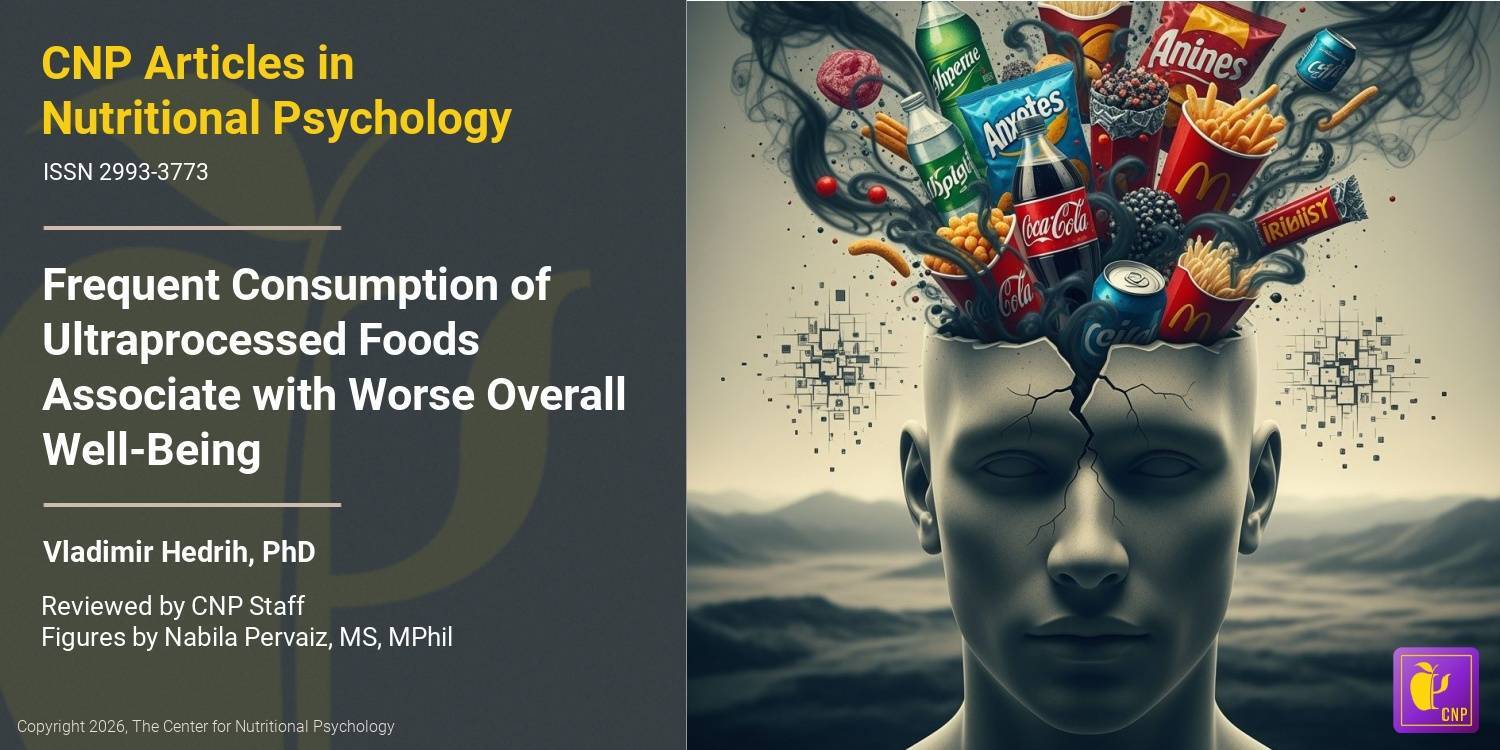
  • Frequent Consumption of Ultra-Processed Foods is Associated with Worse Overall Well-Being

    Frequent Consumption of Ultra-Processed Foods is...

    March 04 2026
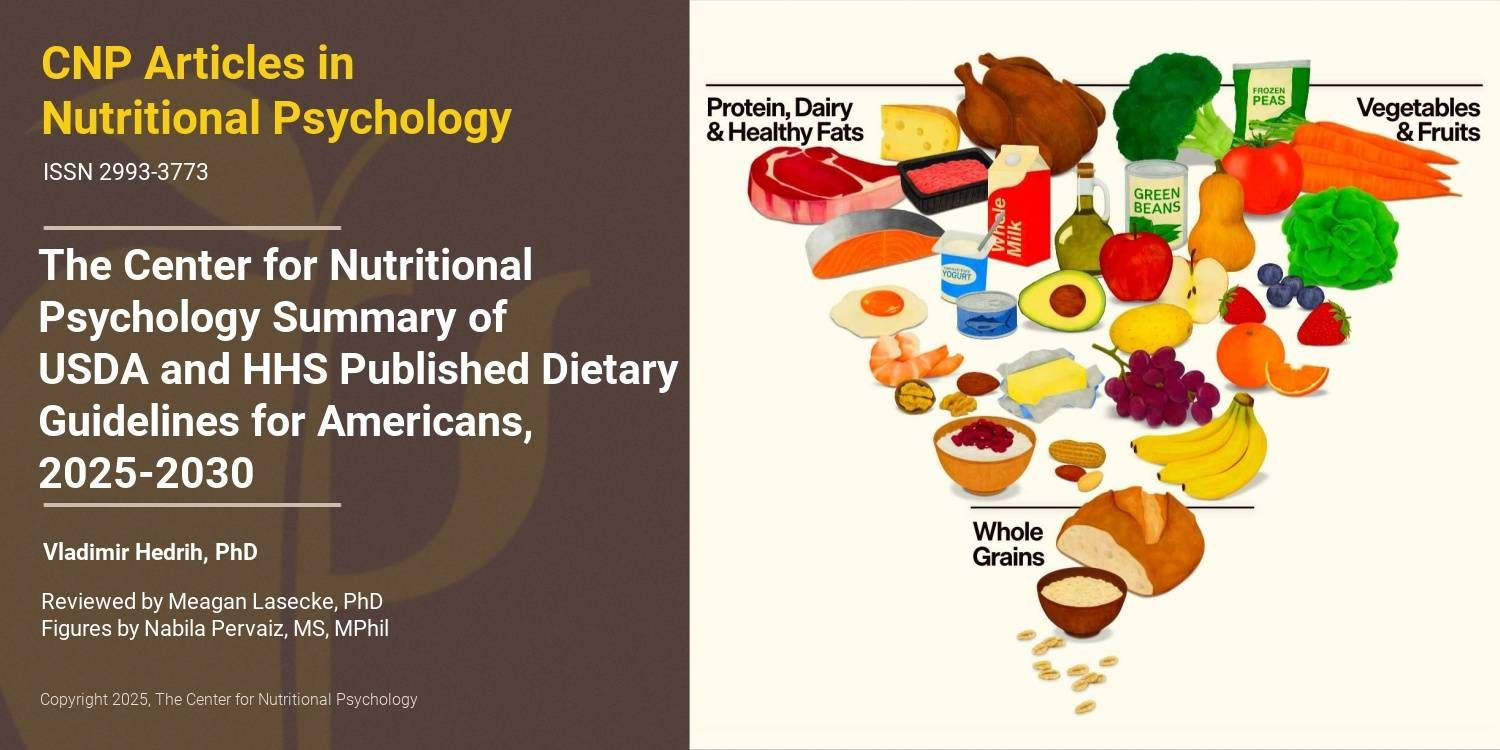
  • The Center for Nutritional Psychology Summary of USDA and HHS Published Dietary Guidelines for Americans, 2025-2030

    The Center for Nutritional Psychology Summary...

    January 31 2026
  • GLP-1RAs Reduce External Eating Behavior in Individuals with Type 2 Diabetes

    GLP-1RAs Reduce External Eating Behavior in...

    December 28 2025

SUPPORT THE FIELD

CNP is a non-profit that relies on our small team of staff and our many dedicated volunteers.

If you find nutritional psychology meaningful, please consider supporting our mission in one of the following ways:

Donate Advocate

We would also love to connect with you on social media!

  • Home
  • Our Mission
  • NP Libraries
  • Advocate
  • FAQ
  • Donate
  • Terms of Use
  • Privacy Policy
Copyright © 2026 The Center for Nutritional Psychology. A registered 501(c)(3) non-profit organization. Contact us: info@nutritional-psychology.org
By using this website, you accept and agree to our Terms of Use and Privacy Policy. The reproduction and/or use of logos, diagrams, or
written content found on this site without explicit permission from the CNP Board of Directors is strictly prohibited.
avatar

Stay Informed

Subscribe to our monthly NEWSLETTER for the latest information on nutritional psychology courses and developments within CNP.
Quarterly Newsletter
Weekly News in Nutritional Psychology
We use cookies to ensure that we give you the best experience on our website. If you continue to use this site we will assume that you are happy with it.