Navigation



ADHD symptom severity may be associated with deficits of specific nutrients

 Watch on YouTube
- A small study published in Frontiers in Nutrition identified specific nutritional insufficiencies in individuals with ADHD, both children and adults.
- Children with lower red blood cell magnesium tended to have higher disruptive behavior scores, as evaluated by parents.
- Individuals with higher learning and language disorder scores tended to have lower omega-3 values.
- Over 80% of participants were intolerant to cow’s milk or other dairy products, 53% were intolerant to wheat, and 42% were intolerant to gluten.
Attention-deficit/hyperactivity disorder, or ADHD, is a neurodevelopmental disorder characterized primarily by persistent patterns of inattention and/or hyperactivity and impulsivity that interfere with everyday functioning (Drechsler et al., 2020; Faraone et al., 2015). It typically emerges during childhood, but it is most often diagnosed when a child starts school, as symptoms of the disorder conflict with school rules and expectations that children sit in their assigned places and pay attention to lectures.
In spite of the fact that ADHD is most often studied in children, symptoms and impairments associated with it frequently persist into adolescence and adulthood. The disorder is relatively common. A recent study estimated that approximately 5% of people suffer from ADHD, while a 2009 meta-analysis reported that 2.5% of adults meet diagnostic criteria (Drechsler et al., 2020; Simon et al., 2009).
People suffering from ADHD differ substantially in how their symptoms present, how severe they are, how they develop and progress, and how much impairment they create in everyday life. Also, twin and family studies indicate that ADHD is highly heritable (Faraone & Larsson, 2019; Grimm et al., 2020).
ADHD is frequently accompanied by other psychiatric and neurodevelopmental conditions (Drechsler et al., 2020). Among other things, some recent findings indicate that individuals with ADHD frequently also suffer from avoidant restrictive food intake disorder (ARFID)(Hunter et al., 2025). Avoidant Restrictive Food Intake Disorder is an eating disorder in which an individual persistently restricts their own food intake or avoids food, leading to inadequate nutrition and creating significant psychosocial impairments.
What Did the Study Examine?
Study author Catherine Hunter and her colleagues explored the role of nutrition in ADHD (Hunter et al., 2025). They note that little research reports vitamin, mineral, and omega-3 fatty acid levels in individuals with ADHD. This study aimed to assess whether blood levels of these key nutrients were lower than recommended dietary reference intakes in individuals with ADHD and similar conditions.
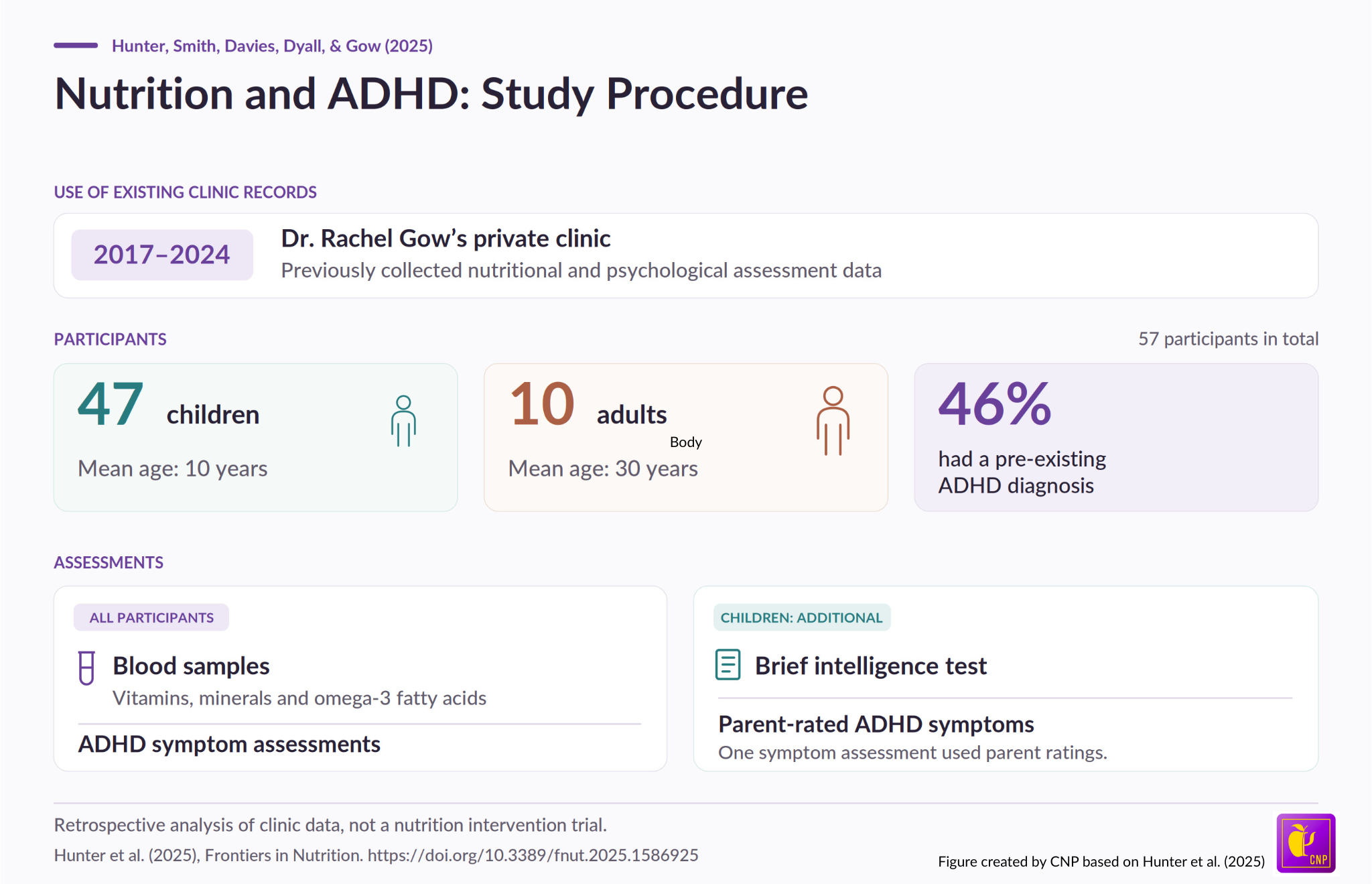
They analyzed data previously collected at Dr. Rachel Gow’s private clinic as part of nutritional and psychological assessments conducted between 2017 and 2024. In total, their sample consisted of 47 children and 10 adults. Children’s mean age was 10 years, while adults’ mean age was 30 years. 46% of them had a pre-existing diagnosis of ADHD. Participants gave blood samples and completed assessments of ADHD symptoms. Children also completed a brief intelligence test, and one assessment of their ADHD symptoms was based on parent-provided ratings (see Figure).
Key Findings
Results showed that 72% of children with ADHD suffered from at least one additional mental health issue. This was most often generalized anxiety disorder (28%). 21% had social communication difficulties, 18% had sensory issues, while 16% showed traits and symptoms related to autism spectrum disorder. 30% of participants with ADHD were taking medication for it, most often methylphenidate.
72% of children with ADHD suffered from at least one additional mental health issue
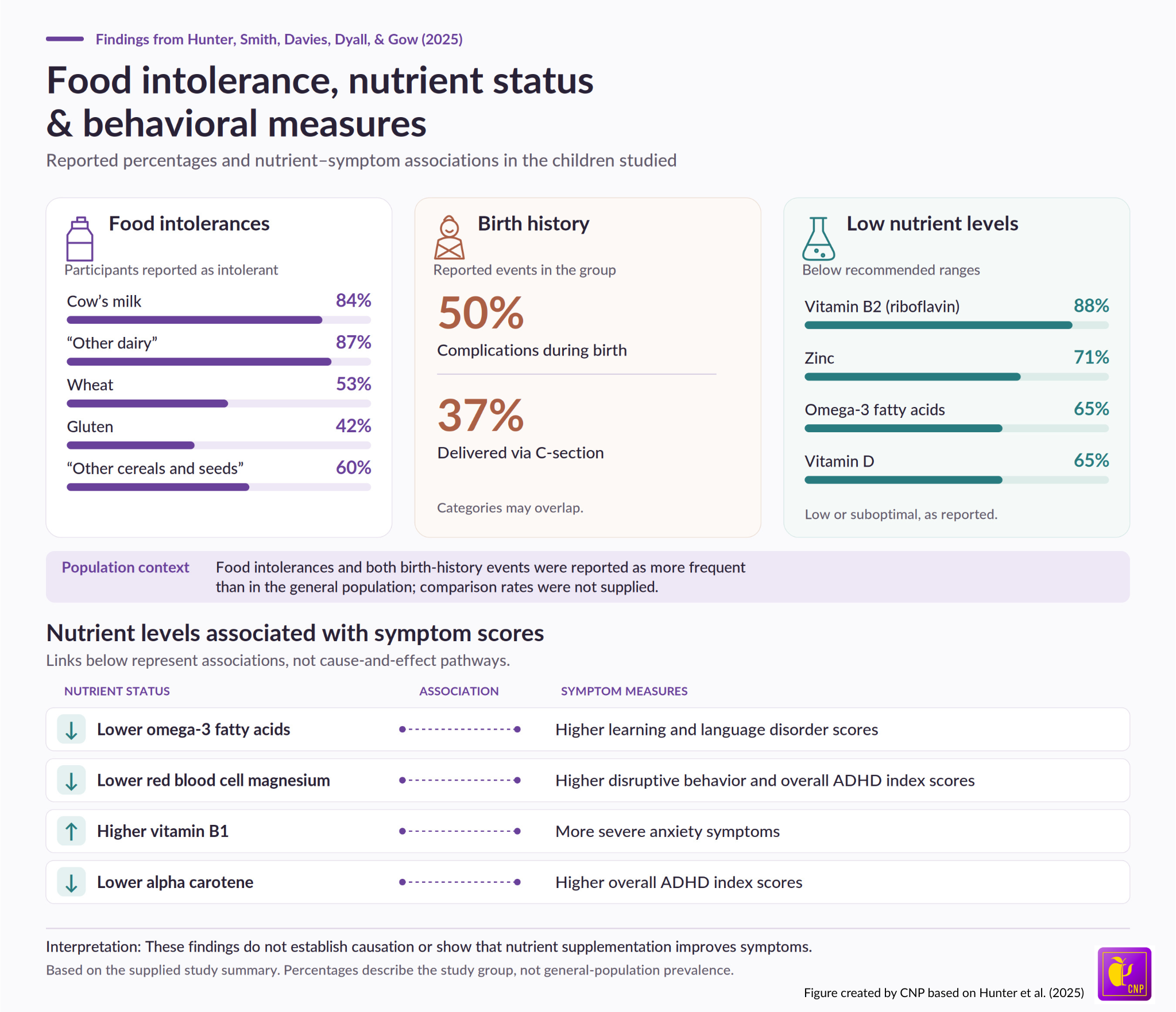
84% of participants showed intolerance to cow’s milk, 87% to “other dairy”, 53% had intolerance to wheat, 42% to gluten, and 60% to the category “other cereals and seeds”. These percentages are substantially higher than estimates typically reported in the general population, suggesting that different food intolerances were much more common in this group than in the general population.
In the group of children, 50% experienced complications during birth, and 37% were delivered via C-section. Both of these categories of events were more frequent than in the general population.
Further analyses showed that very substantial percentages of children had levels of specific micronutrients below recommended ranges. For example, 65% had suboptimal omega-3 fatty acid levels, 65% had low vitamin D levels, 88% had low vitamin B2 (riboflavin) levels, and 71% had low zinc levels.
Most importantly, lower levels of omega-3 fatty acids were associated with higher scores on measures of learning and language disorders. Higher disruptive behavior scores and higher overall ADHD index scores were associated with lower red blood cell magnesium levels. Higher vitamin B1 values were associated with more severe anxiety symptoms. Participants with higher overall ADHD index scores tended to have lower levels of alpha carotene.
Why it matters
This is one of the few studies that examined the links between nutritional factors and ADHD symptoms. While studies often explore neurological, genetic, psychological, social, and even environmental correlates of ADHD symptoms, scientists rarely look into links with nutrition.
Lower levels of omega-3 fatty acids were associated with higher scores on learning and language disorder measures
Moreover, the study identified multiple nutrition-related factors associated with ADHD symptoms, although the mechanisms behind these associations remain mostly unclear at this point.
Limitations to Consider
Although the study contributes to the increasing scientific attention to the links between nutrition and ADHD, it was conducted on a very small sample of participants, all of whom were recruited from a single clinic in the UK. This limits the generalizability of the findings. Additionally, the design of this study does not permit causal inference from the results.
The Bottom Line
Overall, the study identified a number of nutrition-related specificities of individuals with ADHD. The prevalence of intolerance to different foods, ranging from wheat and gluten to dairy, was higher than typical estimates for the general population. Shares of participants with suboptimal levels of different nutrients were also higher than in the general population, and less favorable levels of several micronutrient types were associated with more severe ADHD symptoms.
Study authors report that the detected nutritional insufficiencies are linked to neurotransmitter function. Because of this, they may have implications for learning, behavior, and mood. Further studies might establish specific causal links between ADHD symptoms and specific aspects of nutrition, potentially opening ways to favorably affect ADHD symptoms through improvements in nutrition.
The paper “A closer look at the role of nutrition in children and adults with ADHD and neurodivergence” was authored by Catherine Hunter, Carla Smith, Emily Davies, Simon C. Dyall, and Rachel V. Gow.
Frequently Asked Questions
Attention-deficit/hyperactivity disorder, or ADHD, is a neurodevelopmental disorder characterized primarily by persistent patterns of inattention and/or hyperactivity and impulsivity that interfere with everyday functioning
Participants were 47 children and 10 adults recruited through a private clinic in the UK.
The study identified a number of nutrition-related specificities of individuals with ADHD. A large proportion of participants were found to be intolerant to cow’s milk, dairy, wheat, or gluten. Also, a large majority of participants showed suboptimal levels of micronutrients such as omega-3 fatty acids, vitamins D and B2, or zinc. These issues were much more frequent than estimates for the general population. Levels of some micronutrients were associated with ADHD symptom severity.
Lower levels of omega-3 fatty acids were associated with higher scores on measures of learning and language disorders. Higher disruptive behavior scores and higher overall ADHD index scores were associated with lower levels of red blood cell magnesium. Higher vitamin B1 values were associated with more severe anxiety symptoms. Participants with higher overall ADHD index scores tended to have lower levels of alpha carotene.
References
Drechsler, R., Brem, S., Brandeis, D., Grünblatt, E., Berger, G., & Walitza, S. (2020). ADHD: Current Concepts and Treatments in Children and Adolescents. Neuropediatrics, 51(05), 315–335. https://doi.org/10.1055/s-0040-1701658
Faraone, S. V., Asherson, P., Banaschewski, T., Biederman, J., Buitelaar, J. K., Ramos-Quiroga, J. A., Rohde, L. A., Sonuga-Barke, E. J. S., Tannock, R., & Franke, B. (2015). Attention-deficit/hyperactivity disorder. Nature Reviews Disease Primers, 1(1), 15020. https://doi.org/10.1038/nrdp.2015.20
Faraone, S. V., & Larsson, H. (2019). Genetics of attention deficit hyperactivity disorder. Molecular Psychiatry, 24(4), 562–575. https://doi.org/10.1038/s41380-018-0070-0
Grimm, O., Kranz, T. M., & Reif, A. (2020). Genetics of ADHD: What Should the Clinician Know? Current Psychiatry Reports, 22(4), 18. https://doi.org/10.1007/s11920-020-1141-x
Hunter, C., Smith, C., Davies, E., Dyall, S. C., & Gow, R. V. (2025). A closer look at the role of nutrition in children and adults with ADHD and neurodivergence. Frontiers in Nutrition, 12, 1586925. https://doi.org/10.3389/fnut.2025.1586925
Simon, V., Czobor, P., Bálint, S., Mészáros, Á., & Bitter, I. (2009). Prevalence and correlates of adult attention-deficithyperactivity disorder: Meta-analysis. The British Journal of Psychiatry, 194(3), 204–211. https://doi.org/10.1192/bjp.bp.107.048827
Last updated: