Navigation



Where Nutrition and Mental Health Practice Overlap: What a New Study Reveals

 Watch on YouTube
- A study published in Nutrients explored how often mental health professionals address nutrition and how often nutrition professionals address mental health in their professional work.
- Across all professional groups, the results showed that the vast majority of nutrition and mental health professionals address the complementary area (mental health or nutrition) at least occasionally.
- Nutrition professionals reported receiving more of both formal and informal training in the complementary field. However, formal training and experience in interprofessional collaboration remained limited.
A study published in Nutrients explored how often mental health professionals address nutrition as well as how often nutrition professionals address mental health in their professional work
Across the full professional groups, the results showed that a vast majority of nutrition and mental health professionals deal with the complementary area (mental health or nutrition) at least occasionally.
Nutrition professionals reported receiving more of both formal and informal training in the complementary field. However, formal training and experience of interprofessional collaboration remained limited.
Changes in mental health are often associated with changes in nutrition. It is well established that mental health conditions such as stress and anxiety tend to be associated with poorer diet quality. Similarly, other studies have shown that good nutrition is associated with better mental health, including reduced depression, anxiety, and stress, as well as overall mental well-being (e.g., Frade et al., 2026; Gillespie et al., 2025; Grajek et al., 2022; Solomou et al., 2023).
Mental health conditions such as stress and anxiety tend to be associated with poorer diet quality.
This association is also probably known to most people from everyday personal experience – when we are not feeling well, when we are ill or depressed, we may be less motivated to invest effort in preparing or procuring nutritious food. Also, substantial evidence indicates that food insecurity or unavailability may worsen mental health long before symptoms of major nutrient deficits become apparent (Buch et al., 2023; Nagata et al., 2021). On the other hand, a relatively recent study showed that improving the diet of depressed individuals can lead to substantial reductions in depression symptoms (Francis et al., 2019).
In spite of this, until relatively recently, there was little systematic recognition of the importance of nutrition in the psychological sciences and in mental health more broadly, a situation that the development of nutritional psychology as a scientific area started to change.
What Did the Study Examine?
The study conducted by Riccardo Gurrieri and his colleagues aimed to map the extent to which mental health and nutrition professionals currently engage with each other’s domains in clinical practice (Gurrieri et al., 2026). They also wanted to determine the approximate nature and extent of formal and informal training these professionals have on the relationship between mental health and nutrition, and to map the most important barriers to more extensive cooperation between the two areas.
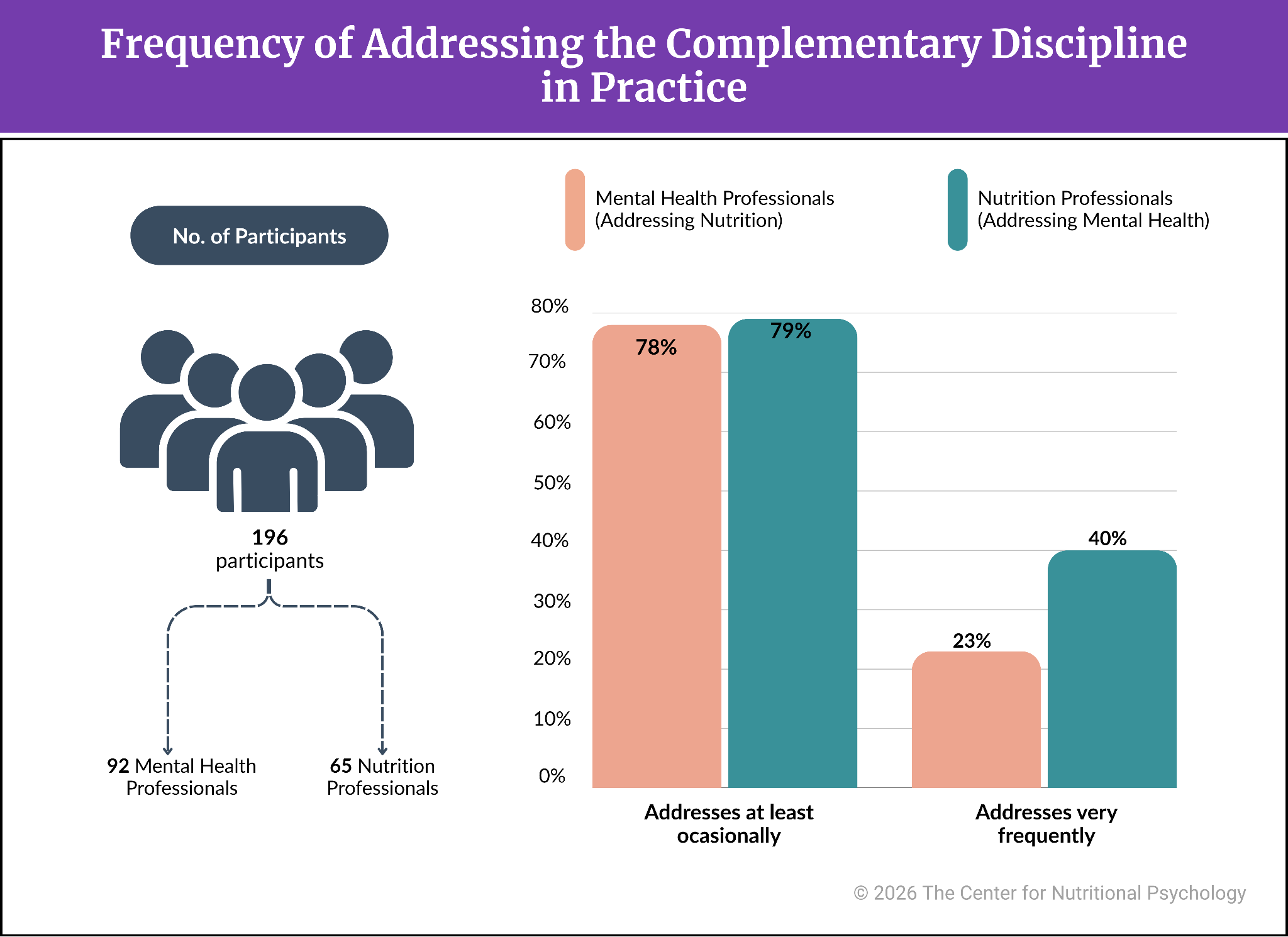
The study used an exploratory, cross-sectional design and analyzed an online convenience sample of 196 participants working in mental health or nutrition, or in training in a relevant field. Of these individuals, 92 were classified as mental health professionals and 65 as nutrition professionals. The other participants belonged to different professions related to mental health or nutrition but were generally not working in clinical practice (e.g., chefs, social workers, educators). Participants were primarily recruited by distributing the survey invitation via the Center for Nutritional Psychology’s professional networks.
Key Findings
Results revealed that 78% of participating mental health professionals reported addressing nutrition in their practice at least occasionally. 23% reported addressing nutrition very frequently. Similarly, 79% of participating nutrition professionals reported discussing mental health in their practice at least occasionally. However, 40% of them reported that they address mental health very frequently. Overall, the results showed that nutrition professionals seem to address mental health in their work somewhat more frequently than mental health professionals address nutrition (see Figure 1).
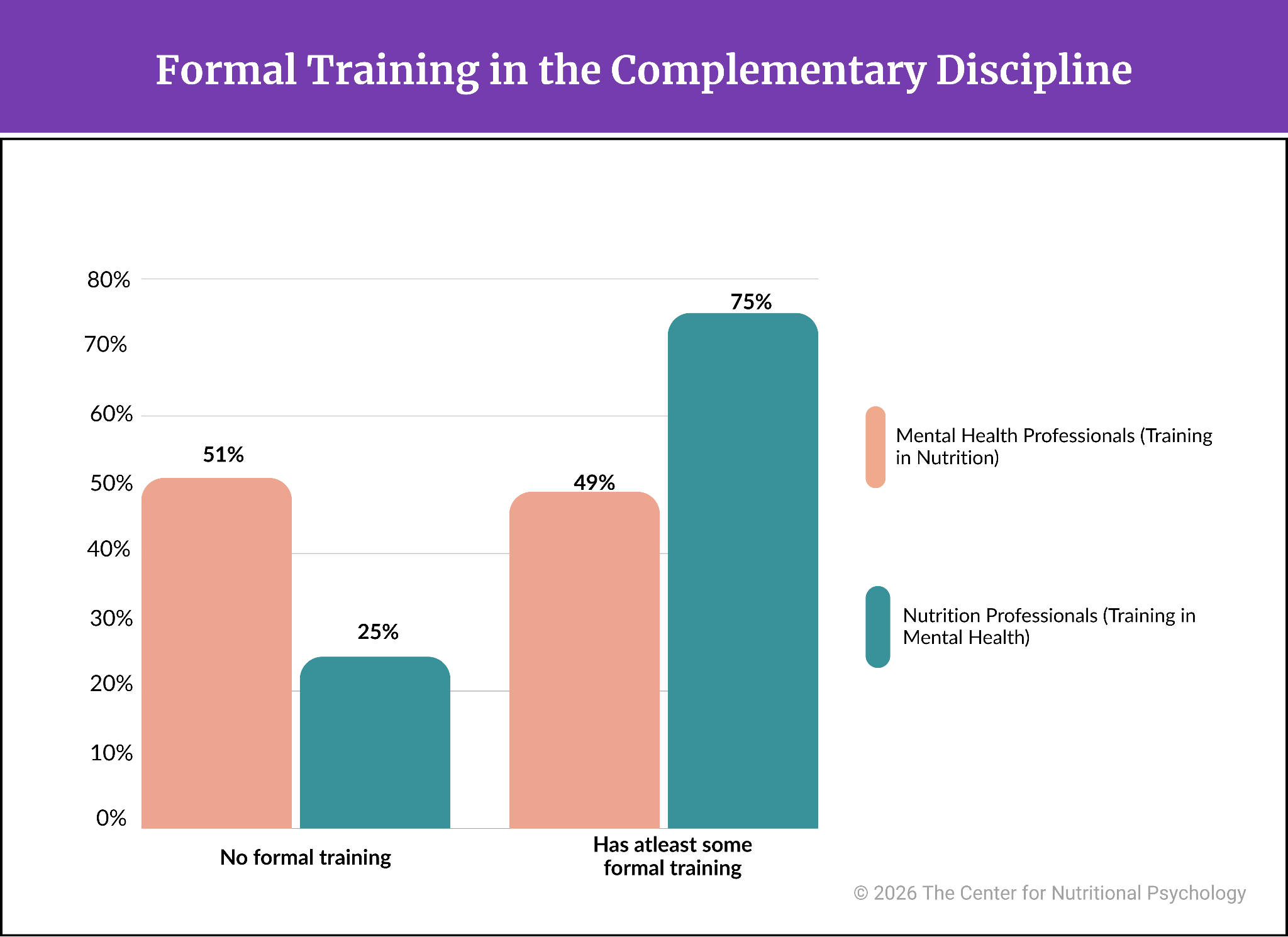
It turned out that nutrition professionals tended to have somewhat more training in mental health (roughly estimated by the number or extent of informal or formal training) than mental health professionals had in nutrition. Still, 51% of mental health professionals reported having no formal training in nutrition-related topics. In contrast, only 25% of nutrition professionals reported having no formal training in the area of mental health (psychology). For both mental health and nutrition professionals, professional certificates or training programs were the most frequent type of formal education in the complementary area (see Figure 2).
78% of participating mental health professionals reported addressing nutrition in their practice at least occasionally.
Study participants rated six predefined barriers to integrating nutrition into mental healthcare. The structure of their answers indicated that these barriers can be grouped into professional barriers (lack of training, lack of common language, unclear professional boundaries) and resource barriers (limited access to nutrition resources, time constraints in sessions), with professional barriers generally rated as more important by both nutrition and mental health professionals.
Why it matters
These findings show that nutrition and mental health topics frequently arise across professional boundaries. However, traditional training programs in the psychological and mental health professions include very little nutrition-related content, when they contain it at all. Similarly, while programs for training nutrition professionals traditionally do cover the importance of adequate nutrition for maintaining physical health, the focus on links with mental health is much rarer.
These findings show that nutrition and mental health topics do come up relatively frequently in the practice of the other area, highlighting the importance of including topics on the diet-mental health links in the training of these two categories of professions.
Limitations to Consider
The participants of this study were individuals recruited through the professional network of the Center for Nutritional Psychology. This might mean that individuals interested in the links between nutrition and mental health were overrepresented in the study sample. Additionally, the results were based on participants’ self-reports collected via a survey, leaving room for reporting bias.
The Bottom Line
Results indicate that most mental health professionals address nutrition topics in their practice at least occasionally, and that nutrition professionals address mental health topics even more frequently. However, scientific knowledge about links between diet and mental health (and psychological processes in general) is traditionally scarcely included in the training programs for these professions. Part of the reason for this is that much of the most important scientific work and discoveries in the area have been made relatively recently. Overall, the study indicates a need to include topics on the links between nutrition and psychological processes in the training of both mental health and nutrition professionals.
The paper “Integrating Nutrition into Mental Health Care: An Exploratory Cross-Sectional Survey of Training, Practices, Barriers, and Collaboration Among Mental Health and Nutrition Professionals” was authored by Riccardo Gurrieri, Vladimir Hedrih, and Ephi Morphew-Lu
Frequently Asked Questions
78% reported addressing nutrition at least occasionally, while 23% said they do so very frequently.
79% reported addressing mental health at least occasionally, and 40% said they do so very frequently.
Lack of training received the highest average rating, followed by unclear professional boundaries and lack of a common language. Lack of evidence received the lowest average rating.
Nutrition and mental health issues frequently overlap in professional practice, but training about their relationship remains limited, indicating a need for more education in both professions.
References
Buch, L., Alvarado, A., Oo, T., Salman, I., Hauber, C., Dutka, P., & Martirosyan, D. (2023). The Impact of Food Deprivation and Starvation on Mental Health: Blockade on Artsakh (Nagorno – Karabakh). Functional Food Science, 3(8), 154. https://doi.org/10.31989/ffs.v3i8.1204
Frade, E., Werneck, A., Segala, G. D., Ashtree, D., Jacka, F., Neil, A. O., Orr, R., Louzada, M. L., & Levy, R. B. (2026). Prospective associations between dietary risk factors and depressive symptoms: Results from the NutriNet-Brasil cohor. https://doi.org/10.31234/osf.io/9m5pu_v2
Francis, H. M., Stevenson, R. J., Chambers, J. R., Gupta, D., Newey, B., & Lim, C. K. (2019). A brief diet intervention can reduce symptoms of depression in young adults – A randomised controlled trial. PLOS ONE, 14(10), e0222768. https://doi.org/10.1371/journal.pone.0222768
Gillespie, K. M., White, M. J., Kemps, E., & Bartlett, S. E. (2025). Vegetable and Fruit Consumption and Psychological Distress: Findings from Australian National Health Survey Data, 2011–2018. International Journal of Environmental Research and Public Health, 22(7), 1037. https://doi.org/10.3390/ijerph22071037
Grajek, M., Krupa-Kotara, K., Białek-Dratwa, A., Sobczyk, K., Grot, M., Kowalski, O., & Staśkiewicz, W. (2022). Nutrition and mental health: A review of current knowledge about the impact of diet on mental health. Frontiers in Nutrition, 9. https://doi.org/10.3389/fnut.2022.943998
Gurrieri, R., Hedrih, V., & Morphew-Lu, E. (2026). Integrating Nutrition into Mental Health Care: An Exploratory Cross-Sectional Survey of Training, Practices, Barriers, and Collaboration Among Mental Health and Nutrition Professionals. Nutrients, 18(16), 2601. https://doi.org/10.3390/nu18162601
Nagata, J. M., Ganson, K. T., Whittle, H. J., Chu, J., Harris, O. O., Tsai, A. C., & Weiser, S. D. (2021). Food Insufficiency and Mental Health in the U.S. During the COVID-19 Pandemic. American Journal of Preventive Medicine, 60(4), 453–461. https://doi.org/10.1016/j.amepre.2020.12.004
Solomou, S., Logue, J., Reilly, S., & Perez-Algorta, G. (2023). A systematic review of the association of diet quality with the mental health of university students: Implications in health education practice. Health Education Research, 38(1), 28–68. https://doi.org/10.1093/her/cyac035 Questions and answers 1) How often do mental health professionals address nutrition in their practice? 78% reported addressing nutrition at least occasionally, while 23% said they do so very frequently. 2) How often do nutrition professionals address mental health in their practice? 79% reported addressing mental health at least occasionally, and 40% said they do so very frequently. 3) What were the main perceived barriers to integrating nutrition into mental healthcare? Lack of training received the highest average rating, followed by unclear professional boundaries and lack of a common language. Lack of evidence received the lowest average rating. 4) What is the main conclusion of the study? Nutrition and mental health issues frequently overlap in professional practice, but training about their relationship remains limited, indicating a need for more education in both professions.
Last updated: