Navigation
  • Nutritional psychology
    • Home
    • What is Nutritional Psychology
    • Training in NP
    • About CNP
    • Meet the Team
    • NP FAQs
  • Education
    • Programs
    • Certificates
    • Courses
      • Overview
      • NP 110
      • NP 120
        • NP 120 Part I
        • NP 120 Part II
      • NP 150
        • NP 150 Part I
        • NP 150 Part II
      • NP 300
        • NP 310
        • NP 320
      • NP 500
    • Micro-Degree
    • Course Scholarships
    • Learner Login
  • RESEARCH LIBRARY (NPRL)
    • Library Intro
    • Adult Population
    • Youth Population
      • Child and Adolescent
      • Neurodevelopmental
      • Maternal
      • Cooking
    • Membership
  • Resources
    • CNP Resources
      • Events
      • CNP News
      • Videos
      • Books
      • Reports
    • Encyclopedia
    • CNP Articles
    • Related Resources
    • Newsletter
  • Get Involved
    • Donate
    • Advocate
      • Introduction
      • Students
      • Professionals
      • Educators
      • Organization Advocacy
      • General
    • Be a Contributor
    • Faces of Nutritional Psychology
      • Faces Home
      • Personal Stories
      • Submission Guidelines
    • Newsletter
    • Research Announcement
  • Membership
    • Introduction
    • LOGIN
  • Contact
  • MEMBER LOGIN
  • STUDENT LOGIN
  • Nutritional psychology
    • Home
    • What is Nutritional Psychology
    • Training in NP
    • About CNP
    • Meet the Team
    • NP FAQs
  • Education
    • Programs
    • Certificates
    • Courses
      • Overview
      • NP 110
      • NP 120
        • NP 120 Part I
        • NP 120 Part II
      • NP 150
        • NP 150 Part I
        • NP 150 Part II
      • NP 300
        • NP 310
        • NP 320
      • NP 500
    • Micro-Degree
    • Course Scholarships
    • Learner Login
  • RESEARCH LIBRARY (NPRL)
    • Library Intro
    • Adult Population
    • Youth Population
      • Child and Adolescent
      • Neurodevelopmental
      • Maternal
      • Cooking
    • Membership
  • Resources
    • CNP Resources
      • Events
      • CNP News
      • Videos
      • Books
      • Reports
    • Encyclopedia
    • CNP Articles
    • Related Resources
    • Newsletter
  • Get Involved
    • Donate
    • Advocate
      • Introduction
      • Students
      • Professionals
      • Educators
      • Organization Advocacy
      • General
    • Be a Contributor
    • Faces of Nutritional Psychology
      • Faces Home
      • Personal Stories
      • Submission Guidelines
    • Newsletter
    • Research Announcement
  • Membership
    • Introduction
    • LOGIN
  • Contact
Login
MEMBER LOGIN STUDENT LOGIN
Conceptual Developments in Nutritional Psychology

Conceptual Developments in Nutritional Psychology (Adult Population)

The CNP Conceptual Development in Nutritional Psychology Research Category consolidates research methods informing the development of the field of Nutritional Psychology. To add these studies to your personal research library in nutritional psychology, join the CNP Library Membership.

Validity and reliability of Food-Mood Questionnaire (FMQ)

  • Karim Maghraby, M.B.B.Ch, M.Sc, Director
  • 29 April 2021
  • Reviewed By CNP STAFF
Logo

This CNP Research Summary is protected. Become a CNP Library Member to access it.

Share this post:

Related Studies

The theory of planned behavior: a review of its applications to health-related behaviors

  • Karim Maghraby, M.B.B.Ch, M.Sc, Director
  • 29 April 2021
  • Reviewed By CNP Staff

The theory of planned behavior This review aims to assess the applications of Ajzen’s theory of planned behavior within the health domain, with a specific focus on its ability to explain and predict health-related behaviors. Methodologically, the review synthesizes data primarily from Current Contents (Social and Behavioral Sciences and Clinical Medicine) spanning from 1985 to […]

Parsing the link between reinforcement sensitivity theory and eating behavior: A systematic review

  • Karim Maghraby, M.B.B.Ch, M.Sc, Director
  • 29 April 2021
  • Reviewed By CNP Staff

The Reinforcement Sensitivity Theory and eating behavior : Exploring their link The Reinforcement Sensitivity Theory (RST) serves as a psychobiological framework for understanding personality traits and their influence on eating behavior. Despite extensive research, the connections between RST factors and specific eating behaviors remain inadequately defined. This systematic review examines these associations using a parsing […]

Recent Articles

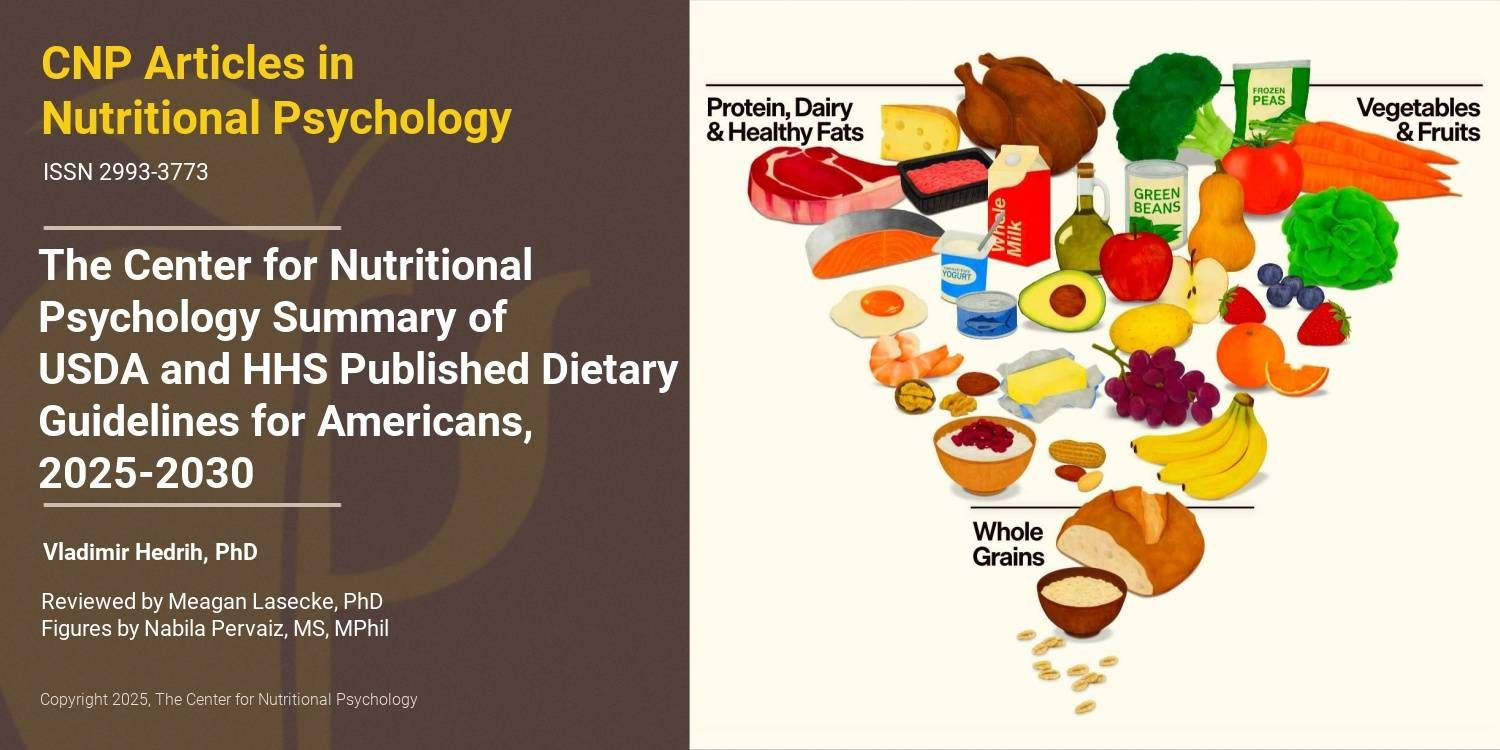
  • The Center for Nutritional Psychology Summary of USDA and HHS Published Dietary Guidelines for Americans, 2025-2030

    The Center for Nutritional Psychology Summary...

    January 31 2026
  • GLP-1RAs Reduce External Eating Behavior in Individuals with Type 2 Diabetes

    GLP-1RAs Reduce External Eating Behavior in...

    December 28 2025
  • Psychological Experiences of Hunger Can Be General or Specific and Depend on Memory

    Psychological Experiences of Hunger Can Be...

    November 10 2025

SUPPORT THE FIELD

CNP is a non-profit that relies on our small team of staff and our many dedicated volunteers.

If you find nutritional psychology meaningful, please consider supporting our mission in one of the following ways:

Donate Advocate

We would also love to connect with you on social media!

  • Home
  • Our Mission
  • NP Libraries
  • Advocate
  • FAQ
  • Donate
  • Terms of Use
  • Privacy Policy
Copyright © 2026 The Center for Nutritional Psychology. A registered 501(c)(3) non-profit organization. Contact us: info@nutritional-psychology.org
By using this website, you accept and agree to our Terms of Use and Privacy Policy. The reproduction and/or use of logos, diagrams, or
written content found on this site without explicit permission from the CNP Board of Directors is strictly prohibited.
avatar

Stay Informed

Subscribe to our monthly NEWSLETTER for the latest information on nutritional psychology courses and developments within CNP.
Quarterly Newsletter
Weekly News in Nutritional Psychology
We use cookies to ensure that we give you the best experience on our website. If you continue to use this site we will assume that you are happy with it.