Navigation
  • Nutritional psychology
    • Home
    • What is Nutritional Psychology
    • Training in NP
    • About CNP
    • Meet the Team
    • NP FAQs
  • Education
    • Programs
    • Certificates
    • Courses
      • Overview
      • NP 110
      • NP 120
        • NP 120 Part I
        • NP 120 Part II
      • NP 150
        • NP 150 Part I
        • NP 150 Part II
      • NP 300
        • NP 310
        • NP 320
    • Micro-Degree
    • Course Scholarships
    • Learner Login
  • RESEARCH LIBRARY (NPRL)
    • Library Intro
    • Adult Population
    • Youth Population
      • Child and Adolescent
      • Neurodevelopmental
      • Maternal
      • Cooking
    • Membership
  • Resources
    • CNP Resources
      • Events
      • CNP News
      • Videos
      • Books
      • Reports
    • Encyclopedia
    • CNP Articles
    • Related Resources
    • Newsletter
  • Get Involved
    • Donate
    • Advocate
      • Introduction
      • Students
      • Professionals
      • Educators
      • Organization Advocacy
      • General
    • Be a Contributor
    • Faces of Nutritional Psychology
      • Faces Home
      • Personal Stories
      • Submission Guidelines
    • Newsletter
    • Research Announcement
  • Membership
    • Introduction
    • LOGIN
  • Contact
  • MEMBER LOGIN
  • STUDENT LOGIN
  • Nutritional psychology
    • Home
    • What is Nutritional Psychology
    • Training in NP
    • About CNP
    • Meet the Team
    • NP FAQs
  • Education
    • Programs
    • Certificates
    • Courses
      • Overview
      • NP 110
      • NP 120
        • NP 120 Part I
        • NP 120 Part II
      • NP 150
        • NP 150 Part I
        • NP 150 Part II
      • NP 300
        • NP 310
        • NP 320
    • Micro-Degree
    • Course Scholarships
    • Learner Login
  • RESEARCH LIBRARY (NPRL)
    • Library Intro
    • Adult Population
    • Youth Population
      • Child and Adolescent
      • Neurodevelopmental
      • Maternal
      • Cooking
    • Membership
  • Resources
    • CNP Resources
      • Events
      • CNP News
      • Videos
      • Books
      • Reports
    • Encyclopedia
    • CNP Articles
    • Related Resources
    • Newsletter
  • Get Involved
    • Donate
    • Advocate
      • Introduction
      • Students
      • Professionals
      • Educators
      • Organization Advocacy
      • General
    • Be a Contributor
    • Faces of Nutritional Psychology
      • Faces Home
      • Personal Stories
      • Submission Guidelines
    • Newsletter
    • Research Announcement
  • Membership
    • Introduction
    • LOGIN
  • Contact
Login
MEMBER LOGIN STUDENT LOGIN
Diet, Aging and Neurodegeneration

Diet, Aging and Neurodegeneration (Adult Population)

The CNP Diet, Aging, and Neurodegeneration Research Category consolidates research exploring the interdependent relationship between dietary intake and aging and neurodegeneration. To view each original study on the open internet, click “Original.” To view the CNP-written abstract summary, click “CNP Summary.” While only some CNP-written abstract summaries are available below for free, all abstract summaries are available to CNP members through the CNP Library Membership.

Green tea catechins attenuate neurodegenerative diseases and cognitive deficits

  • Karim Maghraby, M.B.B.Ch, M.Sc, Director
  • 07 July 2021
  • Reviewed By CNP STAFF
Logo

This CNP Research Summary is protected. Become a CNP Library Member to access it.

Share this post:

Related Studies

Consumption of olive oil and diet quality and risk of dementia-related death

  • Karim Maghraby, M.B.B.Ch, M.Sc, Director
  • 07 July 2021
  • Reviewed By CNP STAFF

This prospective cohort study by Tessier et al. (2024), spanning from 1990 to 2018 and involving participants from the Nurses’ Health Study (NHS) and Health Professionals Follow-Up Study (HPFS), aimed to investigate the association between olive oil consumption and the subsequent risk of dementia-related death. The study also examined the combined effect of olive oil […]

Aging-related decline in the liver and brain is accelerated by refined diet consumption

  • Karim Maghraby, M.B.B.Ch, M.Sc, Director
  • 07 July 2021
  • Reviewed By CNP Staff

Recent studies have indicated that diets high in highly or ultra-processed foods may lead to various diseases. This research investigates the effects of a refined diet, both with and without fiber enrichment, on aging-related health decline in male C57BL/6J mice through two distinct experiments. In Experiment 1, mice were fed either a standard chow or […]

Recent Articles

  • Women Who Eat Healthier and Reduce Sugar Intake Age More Slowly

    Women Who Eat Healthier and Reduce...

    December 01 2025
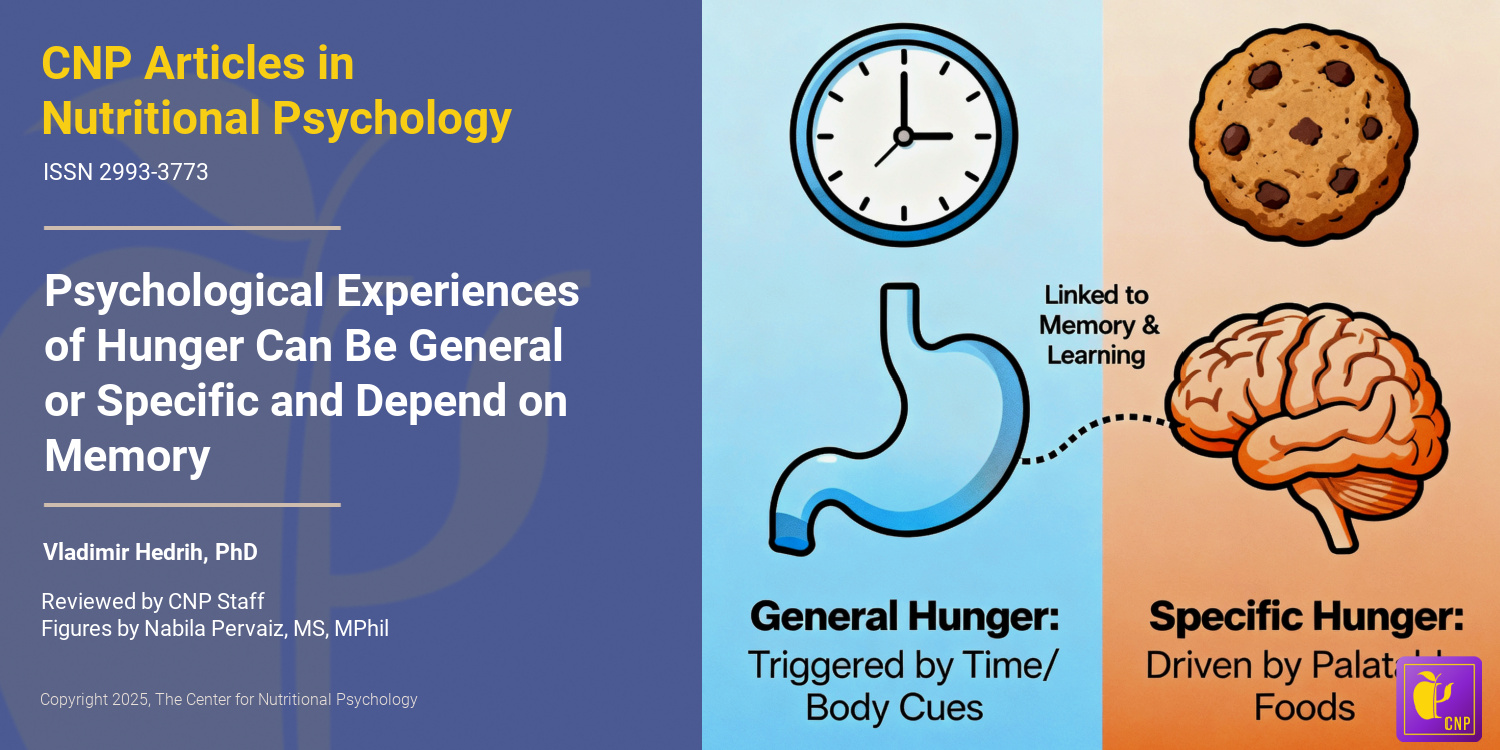
  • Psychological Experiences of Hunger Can Be General or Specific and Depend on Memory

    Psychological Experiences of Hunger Can Be...

    November 10 2025
  • A New Framework for Analyzing Food Flavor Perception

    A New Framework for Analyzing Food...

    October 25 2025

SUPPORT THE FIELD

CNP is a non-profit that relies on our small team of staff and our many dedicated volunteers.

If you find nutritional psychology meaningful, please consider supporting our mission in one of the following ways:

Donate Advocate

We would also love to connect with you on social media!

  • Home
  • Our Mission
  • NP Libraries
  • Advocate
  • FAQ
  • Donate
  • Terms of Use
  • Privacy Policy
Copyright © 2025 The Center for Nutritional Psychology. A registered 501(c)(3) non-profit organization. Contact us: info@nutritional-psychology.org
By using this website, you accept and agree to our Terms of Use and Privacy Policy. The reproduction and/or use of logos, diagrams, or
written content found on this site without explicit permission from the CNP Board of Directors is strictly prohibited.
avatar

Stay Informed

Subscribe to our monthly NEWSLETTER for the latest information on nutritional psychology courses and developments within CNP.
We use cookies to ensure that we give you the best experience on our website. If you continue to use this site we will assume that you are happy with it.