This course prepares professionals to incorporate the Psychonutritional Assessment Battery (PAB) into clinical practice. This battery for Nutritional Psychology professionals comprises 13 validated psychonutritional assessment measures encompassing more than 60 psychological constructs related to eating behavior and mental health. Through in-depth instruction, you’ll gain the skills to evaluate, interpret, and apply these measures in educational and clinical contexts.
Developed through an extensive review of empirically-validated research tools spanning the psychological and nutritional sciences, the course prepares you to integrate research-based assessment scales into clinical practice. By doing so, you can systematically evaluate the complex relationships between diet and mental health, identify meaningful patterns in client behavior, and use these insights to create more targeted and effective treatment plans.
This first-of-its-kind assessment battery in nutritional psychology is rooted in the concepts, methods, evidence base, and language of nutritional psychology and enables you to support the establishment of clear client baselines in the diet-mental health relationship, tailor interventions to individual needs, track progress with measurable outcomes, and adjust strategies based on evidence over time. Ultimately, it enables a more data-informed, transparent, and personalized approach to supporting mental health through nutrition.
Integrating this assessment component into clinical practice can expand both the scope and depth of your work while differentiating your practice by positioning you as a clinician who systematically incorporates nutrition-related psychological assessment into mental health care, attracting clients seeking a more holistic, evidence-informed approach. Prerequisites for this course include completion of Certificates 1 and 2 in nutritional psychology.
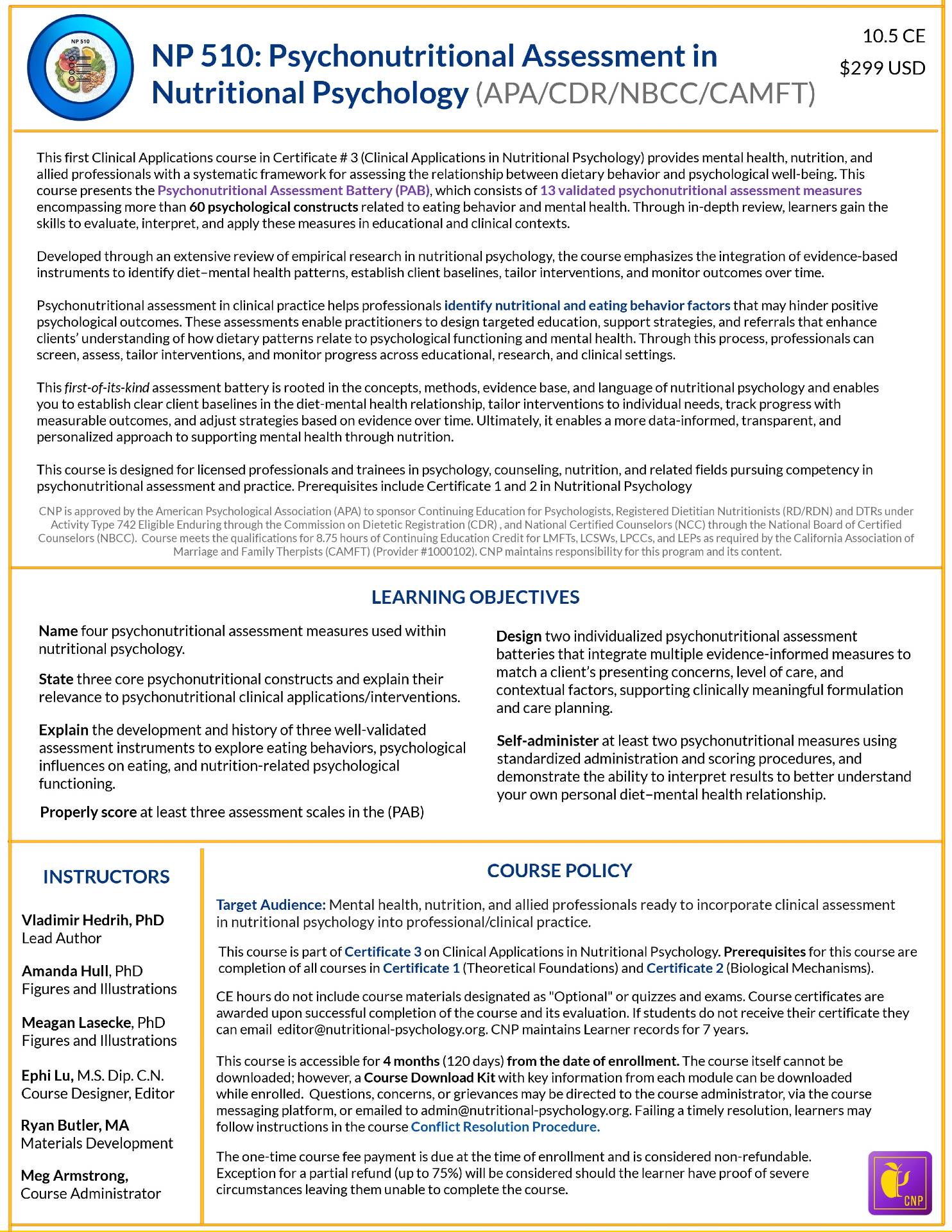
This Clinical Applications course is designed for those who have completed Certificates 1 and 2 (Theoretical Foundations and Biological Mechanisms) in the CNP Micro-Degree pathway. This course is designed for licensed professionals and trainees in psychology, counseling, nutrition, and related fields pursuing competency in psychonutritional assessment and practice. See the Course Flyer.
NP 510 is fully online, self-paced, and text-based, with figures/tables and voiced videos, a final exam, and a course evaluation. The pace at which you complete this course will depend on your personal reading, comprehension, and learning style. Once enrolled, you will have full online access for 4 months (120 days), which must be completed (along with the course evaluation) in full to receive credit and a Certificate of Completion. While this course is not downloadable, a Course Download Kit containing all of the terms and definitions, figures, case studies, and APA-formatted references is provided.
CNP is approved to sponsor Continuing Education (CE) for professionals through the following organizations:
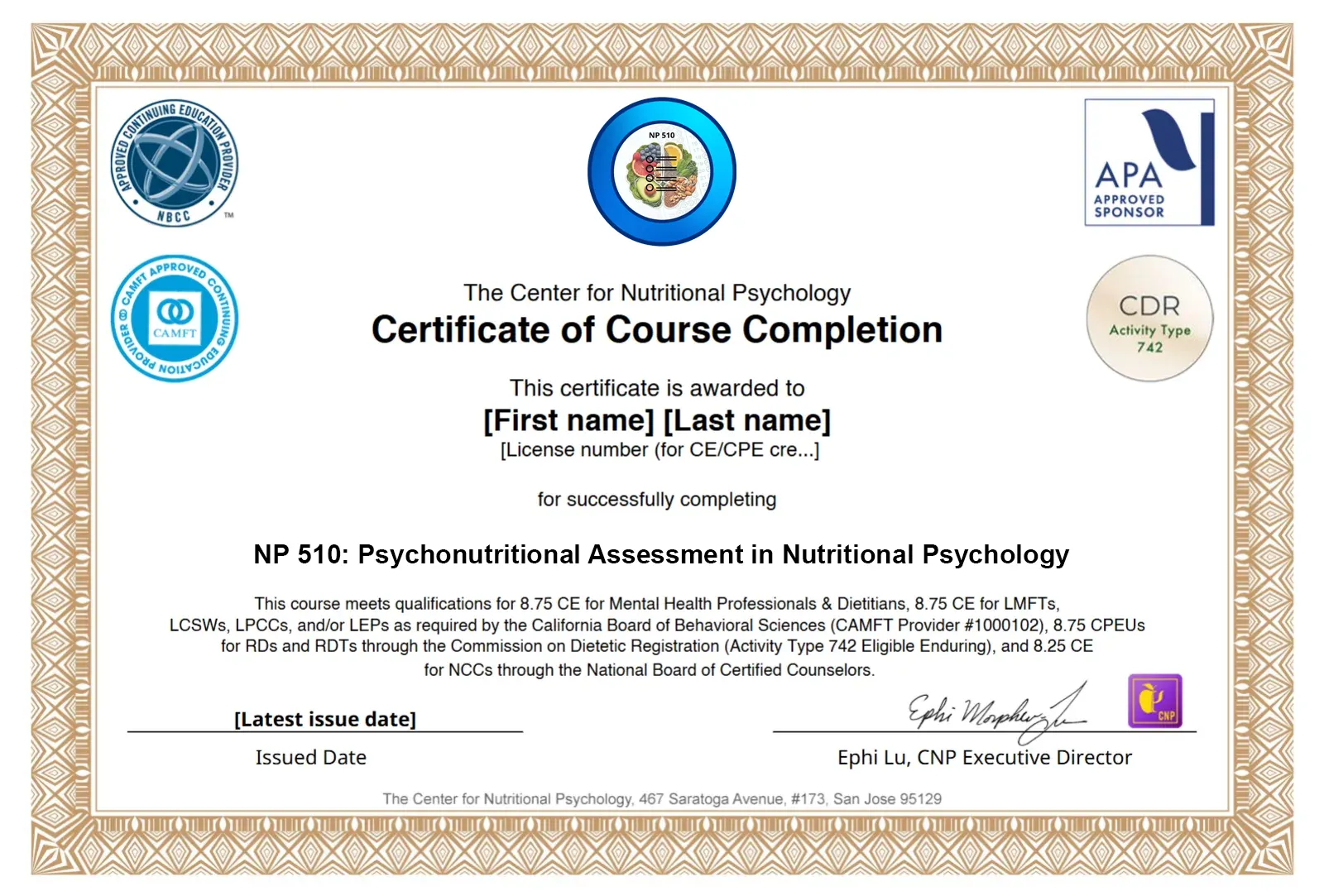
This course provides 10.5 CE for Psychologists, RDs, DTRs, LMFTs, LCSWs, LPCCs, LEPs, and National Certified Counselors (NCCs).
CNP maintains responsibility for this program and its content. CNP, the organization offering this course, is committed to ethical standards, resolving conflicts of interest in its programs, and ensuring unbiased, evidence-based education. Registering for NP 510 indicates that you have read and agreed to CNP’s Course Policy.
CNP is committed to identifying and resolving potential conflicts of interest in planning, promoting, delivering, and evaluating its continuing education curriculum and programs. As an APA-approved continuing education sponsor, and consistent with concepts outlined in the APA Ethical Principles of Psychologists and Code of Conduct, no individual involved in the planning, promotion, delivery, or evaluation of CNP continuing education has any personal, professional, legal, financial, or other interests that could reasonably be expected to impair his, her, or their objectivity, competence, or effectiveness.
CNP upholds the highest ethical standards in developing and delivering its continuing education programs. As an APA-approved sponsor, CNP adheres to the APA Ethical Principles of Psychologists and Code of Conduct. All course content is science-based, free from commercial bias, and developed by individuals with no relevant conflicts of interest. Any potential conflicts are reviewed, resolved, and documented prior to release.
The instructors, Dr. Vladimir Hedrih, Dr. Amanda Hull, and Dr. Meagan Lasecke, affirm that there are no known financial or other conflicts related to this educational activity, and that all relevant relationships have been disclosed and reviewed for objectivity and scientific rigor. Opinions expressed are those of the presenter(s) and do not necessarily reflect the views of the APA or the sponsoring organization.
This course is for NP Learners who have completed the following courses/certificates in nutritional psychology:
This course presents the evidence, knowledge, conceptual learning, and tools needed to incorporate psychonutritional assessment into clinical practice. It does not provide:
This course provides knowledge of the:
A: Yes, completion of Certificate 1 (Theoretical Applications) and 2 (Biological Mechanisms) in nutritional psychology must be completed before you take this first course in Certificate #3. These first two certificates prepare you to understand the language, conceptual framework, and biological mechanisms in the diet-mental health relationship within nutritional psychology, and serve as a backbone for understanding psychonutritional assessment.
A: Yes, this course is taught fully online through the CNP educational platform and can be completed at your own pace. Note: once enrolled, each course has a time limit to complete (usually several months and in NP 510 case -- three months).
A: Yes, NP 510 has open enrollment, and as long as you have completed the course prerequisites (Certificate 1 and 2), you can begin any time.
A: NP 510 is estimated to take 10.5 hours to complete. Completion time also depends on your learning style and previous experience in nutrition and psychology and whether you've taken previous CNP courses. If this information is new to you, or you are a deep learner, it may take more time to complete.
Hedrih, V., Hull, A., Lasecke, M., & Morphew-Lu, E. (2026). NP 510: Psychonutritional assessment in nutritional psychology. In E. Morphew-Lu (Ed.), Certificate #3: Clinical applications in nutritional psychology. Center for Nutritional Psychology. https://www.nutritional-psychology.org/
There are no reviews yet
1. Self-Regulation and Disordered Eating
2. Craving, Reward Sensitivity, and Addictive-Like Eating
3. Dietary Patterns and Food-Mood Connections
4. Mindful and Self-Compassion Dimensions of Eating

This course provides 10.5 CE for Psychologists, Registered Dietitians (RDs), Dietetic Technicians, Registered (DTRs), Licensed Marriage and Family Therapists (LMFTs), Licensed Clinical Social Workers (LCSWs), Licensed Professional Clinical Counselors (LPCCs), Licensed Educational Psychologists (LEPs), and NCCs (National Certified Counselors). To receive credit for this course, learners must complete the course in its entirety and the course evaluation.
NP provides university-level, science-based Continuing Education (CE) for professionals seeking to develop the skills to incorporate psychonutritional assessment within clinical practice.
By integrating the latest research in nutritional psychology, CNP ensures that its courses are rooted in scientifically validated principles, offering a comprehensive and credible foundation for practice. This commitment to science-based education empowers healthcare providers, mental health professionals, nutritionists, and educators to apply cutting-edge insights to their work, bridging the gap between nutrition and psychological well-being.
CNP maintains responsibility for this program and its content. If finances are a barrier to accessing our curriculum, see our NP 110 Scholarship Program.
CNP is approved to sponsor Continuing Education for:
The information in this course is not meant to, nor should it ever be used, to treat, mitigate, or cure psychiatric illness. This information should never be used as a substitute for sound medical advice. This course is educational in nature and is designed to introduce professionals, students, and interested individuals in developing their understanding of the connection between diet and all aspects of psychological functioning and mental health. Best practices for how to integrate this information professionally, ethically, and within the standards of practice will be covered in upcoming courses. While this information can be incorporated into one’s practice within an educational framework, it cannot be used to provide dietary advice, any form of dietary intervention, or to treat any psychological or mental health issues.